
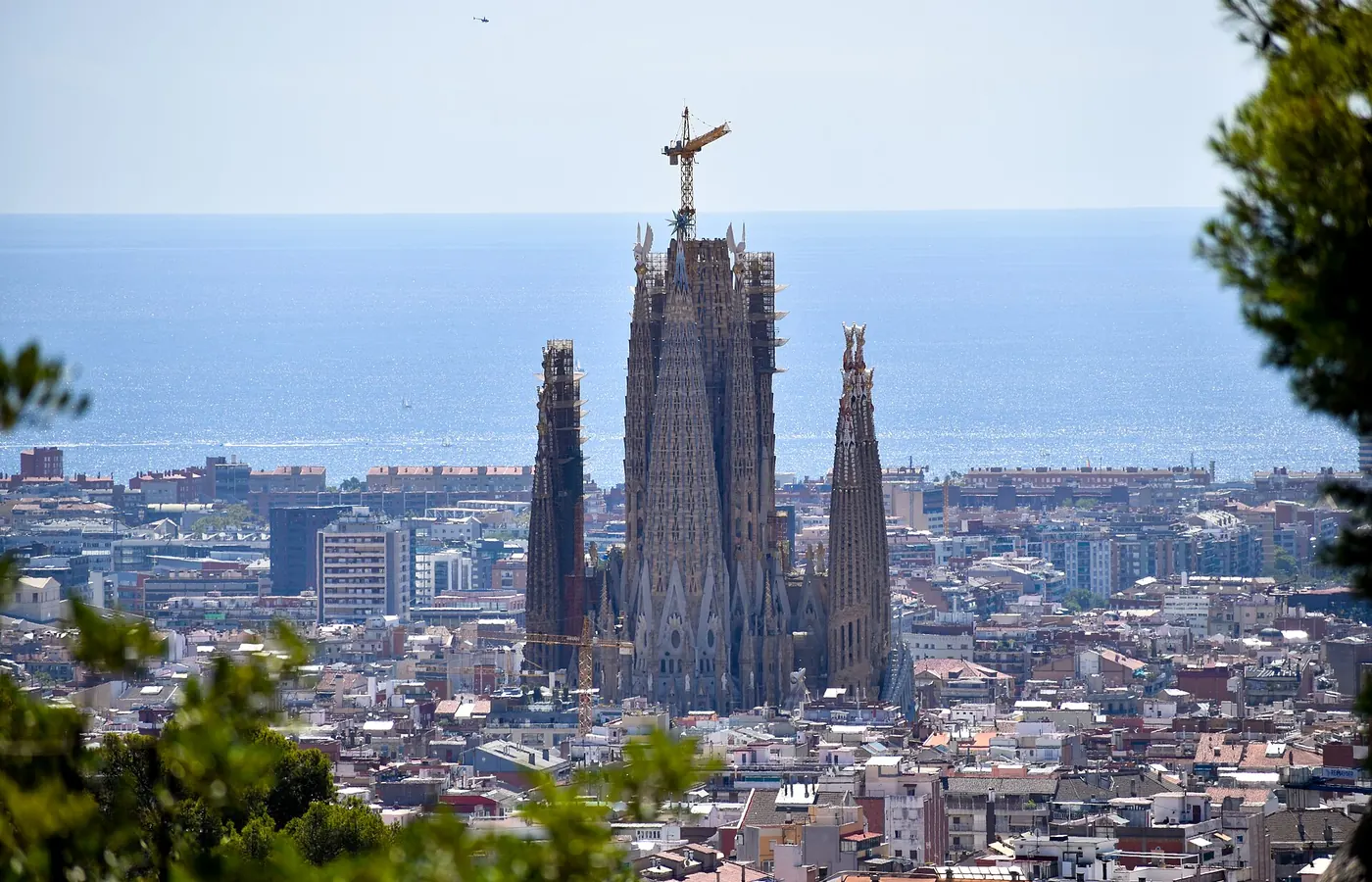
What Barcelona is known for
Barcelona sits between the Mediterranean Sea and the Collserola hills, combining a seaside setting with a distinct urban life. As the capital of Catalonia, it is marked by its bilingual Catalan and Spanish heritage, broad avenues, and an architectural character spanning Roman foundations to modernist townhouses.
Travellers visit to wander pedestrian promenades, relax along the city beaches, and admire the imaginative buildings designed by Antoni Gaudí and Lluís Domènech i Montaner. The city invites exploration on foot, offering sunny plazas, open-air food markets, and a steady Mediterranean pace.
A short history
Before Roman settlement, the coastal plain was inhabited by the Laietani, an ancient Iberian people. Toward the end of the first century BC, the Romans established a fortified colony called Barcino on the small hill of Mont Tàber. Sections of these Roman defensive walls, stone towers, and aqueducts remain visible today in the historic centre.
Following periods of Visigothic and Muslim rule, Barcelona became the seat of the Counts of Barcelona and developed into a major maritime power. During the 13th and 14th centuries, the Crown of Aragon expanded trade networks across the Mediterranean, funding the construction of grand Gothic halls, civic residences, and stone churches.
In the late 19th century, rapid industrial growth, particularly in textiles, reshaped the city. The medieval walls were taken down to allow for the Eixample, a large planned expansion based on a geometric street grid. This era of prosperity sparked the Catalan Renaixença and the Modernisme architectural movement, giving the city its distinctive curving façades, decorative ironwork, and colourful tile mosaics.
The 20th century brought political hardship during the Spanish Civil War and the subsequent Franco dictatorship, which suppressed Catalan institutions. The return of democracy in the late 1970s and the hosting of the 1992 Summer Olympic Games transformed the urban landscape, opening the city toward its waterfront and revitalising old industrial districts into public beaches and parks.
Neighbourhoods
The historic core, Ciutat Vella, contains several distinct quarters. The Gothic Quarter features a maze of narrow stone alleys leading to quiet plazas and Roman ruins, while neighbouring El Born is known for medieval merchant houses and craft workshops. Across the boulevard of La Rambla lies El Raval, a dense and historic quarter shaped by centuries of maritime trade.
North of the old centre, the Eixample spreads out in a precise octagonal grid planned by Ildefons Cerdà, lined with tree-shaded avenues and ornate residential apartment blocks. Further north, the former independent village of Gràcia maintains a low-rise feel with pedestrian streets and lively neighbourhood squares, while Barceloneta preserves its working-class fishing heritage along the harbour and beach.
Food and drink
Catalan cuisine reflects its position between the sea and the inland hills, frequently combining meat and fish in dishes known as mar i muntanya. Everyday staples include pa amb tomàquet—crusty bread rubbed with ripe tomatoes, olive oil, and salt—along with escalivada, made of roasted peppers and aubergines, and cured sausages such as fuet and butifarra. Along the waterfront, rice dishes, seafood stews, and fideuà, a noodle dish cooked with seafood and served with garlic alioli, are common meals, often enjoyed with local cava sparkling wine or still wines from the surrounding Catalan countryside.
Music, arts and culture
Visual art and performance have deep roots across Barcelona. Major collections are housed in institutions such as the Museu Picasso, the Fundació Joan Miró on Montjuïc, and the Museu Nacional d'Art de Catalunya, which holds significant Romanesque and Gothic collections. Concerts and operas take place in historic venues like the Gran Teatre del Liceu and the Palau de la Música Catalana, famous for its stained-glass skylight. Public street festivals, such as La Mercè in September, feature long-standing Catalan traditions, including the building of human towers called castells and the traditional sardana circle dance.
Top things to do
Visitors often begin with the architectural works of Antoni Gaudí, including the Basílica de la Sagrada Família, Park Güell, and the sculptural apartment buildings Casa Batlló and Casa Milà. A walk down the central walkway of La Rambla leads from Plaça de Catalunya past the covered Mercat de la Boqueria toward the Columbus Monument and the harbour.
Montjuïc hill offers views across the port alongside the historic Montjuïc Castle, landscaped public gardens, and former Olympic venues. Along the coast, the wide promenades of Barceloneta and Bogatell provide pleasant routes for cycling, walking along the Mediterranean shoreline, or resting near the water.
Day trips
Outside the city, the jagged peaks of Montserrat make an easy day trip by train, where visitors find a Benedictine monastery situated among high rock formations. To the south, Sitges is a coastal town known for its whitewashed lanes and sandy beaches, reachable by a short train ride. Further north, the provincial capital of Girona features a well-preserved Jewish quarter, medieval defensive walls, and a Gothic cathedral, also within easy reach by rail.
Before you go
Entry rules and travel advice can change. Confirm details with official sources, including the Government of Canada's advice for Spain, before you go.
Best time to go
Late spring and early fall are often comfortable for walking and the beach. Summers can be hot and busy. Winters are milder than in much of Canada, with more rain possible. Official local and Catalan holiday dates affect museum hours.
Getting there from Canada
Flights from Canada typically arrive at Barcelona-El Prat, often via a European hub, with some non-stops. Official airport rail, metro and buses run into the city. The centre is then a mix of Metro and walking.
Official travel advice
Read the Government of Canada's Spain travel advice before you go. Rules and conditions can change.
Search flights, cars, tours and airport rides under Plan your trip below. Checkout is on the partner's site.