
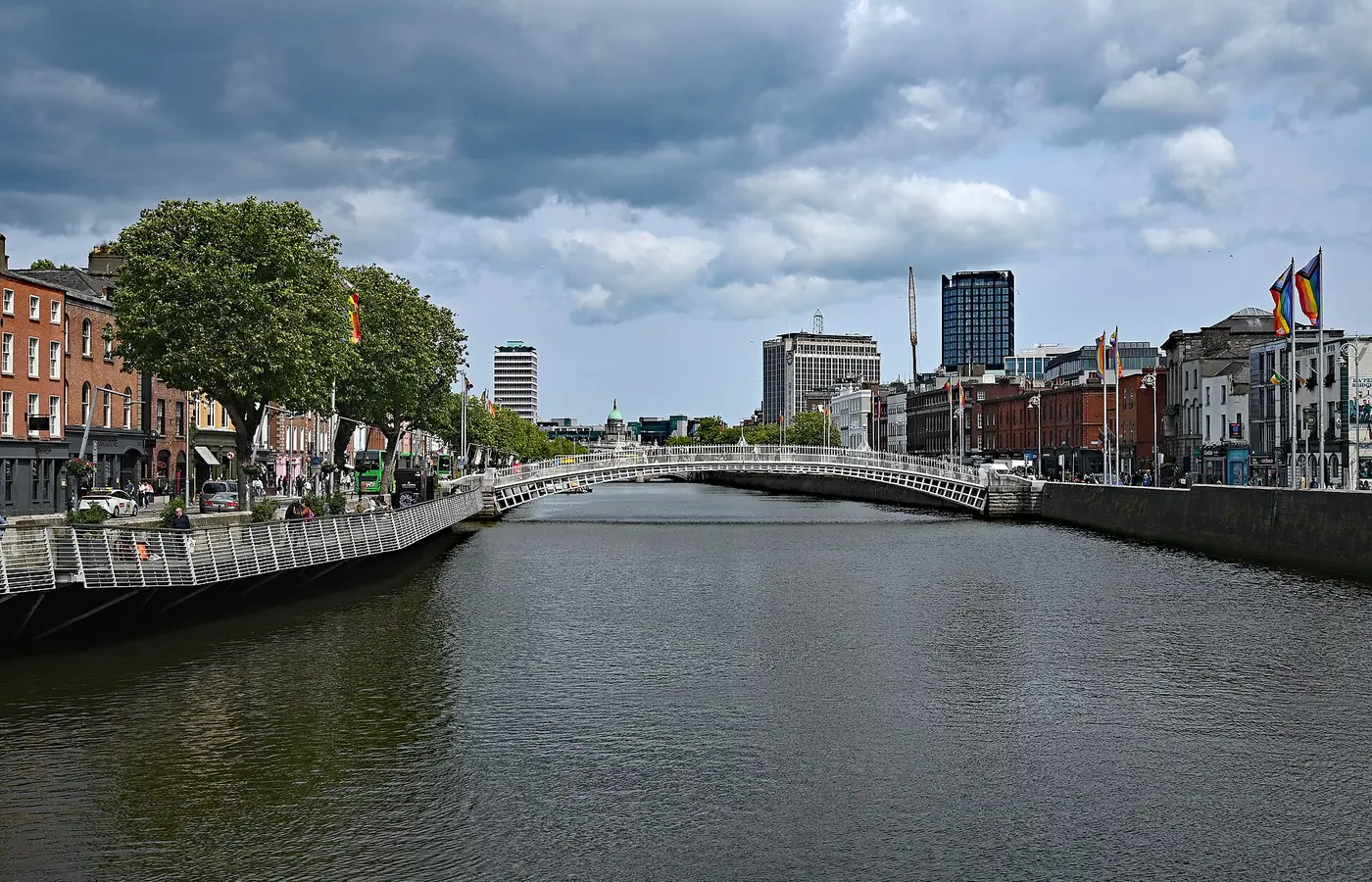
What Dublin is known for
Dublin is an intimate European capital defined by its walkable scale, literary legacy, and location along the River Liffey. Georgian brick townhouses sit minutes away from medieval cathedral walls and pedestrian streets filled with conversation.
The city draws travellers with its deep storytelling tradition, historic public house culture, and coastal setting on Dublin Bay. It offers a comfortable balance between centuries of layered history and modern city life, making it easy to explore on foot.
A short history
Dublin began around a tidal pool where the River Poddle joined the Liffey, a place known as Dubh Linn, alongside a shallow river crossing called Baile Átha Cliath. In the ninth century, Norse raiders established a fortified trading settlement, developing Dublin into a vital maritime port for Viking trade routes across the North Atlantic.
In the late 12th century, Anglo-Norman forces captured the settlement, establishing Dublin as the administrative heart of English rule in Ireland. Over the medieval era, stone walls encircled the growing town, centred on Dublin Castle and Christ Church Cathedral.
The 18th century transformed Dublin into a prominent and rapidly expanding Georgian centre, defined by wide avenues and gracious red-brick squares such as Merrion Square. By the early 20th century, the city became the crucible of the Irish independence movement, with the General Post Office serving as the headquarters during the 1916 Easter Rising.
Modern Dublin preserves this architectural past while thriving as a contemporary European capital, where historic quays along the river stand alongside the glass architecture of the Docklands.
Neighbourhoods
South of the Liffey, the lively brick-paved lanes of Temple Bar sit adjacent to the academic courtyards of Trinity College. Further south along Grafton Street, the tranquil paths of St. Stephen's Green are bordered by Georgian townhouses with colourful front doors. Nearby, the Portobello neighbourhood follows the Grand Canal, offering a relaxed residential atmosphere with leafy towpaths and local markets.
On the north side, wide thoroughfares like O'Connell Street lead toward the cultural institutions around Parnell Square. To the east along the river quays, the Docklands district showcases striking contemporary architecture, footbridges, and open waterfront plazas.
Food and drink
Dublin food traditions centre on comforting, unpretentious dishes made from regional dairy, root vegetables, and fresh seafood. Classic Dublin coddle—a slow-simmered stew of sausages, bacon, and potatoes—remains a historic local favourite, alongside hearty beef stew paired with traditional soda bread. Smoked Atlantic salmon, fresh oysters, and colcannon are widespread staples. For drinks, dry Irish stout and single-pot-still whiskey have long histories here, frequently enjoyed in neighbourhood pubs where lively conversation is the primary draw.
Music, arts and culture
As a designated UNESCO City of Literature, Dublin is celebrated for its deep writing heritage, having produced literary figures such as James Joyce, W.B. Yeats, Oscar Wilde, and Samuel Beckett. This creative energy continues through informal traditional music sessions in neighbourhood pubs, where fiddles, flutes, and bodhráns accompany traditional songs. Major institutions like the Abbey Theatre, the National Gallery of Ireland, and the Irish Museum of Modern Art provide prominent platforms for performing and visual arts.
Top things to do
A classic visit starts with a walk across Trinity College to view the historic Old Library and the medieval Book of Kells. Steps away, travellers can cross the River Liffey via the pedestrian Ha'penny Bridge or explore the grounds of Dublin Castle and the ancient crypts of Christ Church Cathedral and St. Patrick's Cathedral.
To the west, Phoenix Park provides sprawling parkland, tree-lined avenues, and roaming herds of fallow deer. Kilmainham Gaol offers an insightful, solemn look at the figures of Irish revolutionary history, while the National Museum of Ireland sites display prehistoric gold, bog bodies, and Viking artifacts.
Day trips
The coast and countryside surrounding Dublin provide appealing changes of scenery. The historic fishing village of Howth is a short train ride north, featuring coastal cliff walks and harbour views. South of the city, Dalkey and the seaside town of Dún Laoghaire offer stone piers, coastal walks, and historic defensive towers. An easy day trip to the south leads into County Wicklow, where the wooded valleys and ancient monastic ruins of Glendalough sit surrounded by the Wicklow Mountains.
Before you go
Entry rules and travel advice can change. Confirm details with official sources, including the Government of Canada's advice for Ireland, before you go.
Best time to go
Late spring through early fall has the longest days. Rain is possible in any month. Winters are mild compared with much of Canada, but they are damp, windy and dark in late afternoon.
Getting there from Canada
Flights from Canada typically arrive at Dublin Airport, including nonstops from several Canadian cities. Official buses and the Airport Express (and, when it applies, the local rail link) run into the centre. The core is compact and walkable, with buses and some LUAS tram lines.
Official travel advice
Read the Government of Canada's Ireland travel advice before you go. Rules and conditions can change.
Search flights, cars, tours and airport rides under Plan your trip below. Checkout is on the partner's site.