
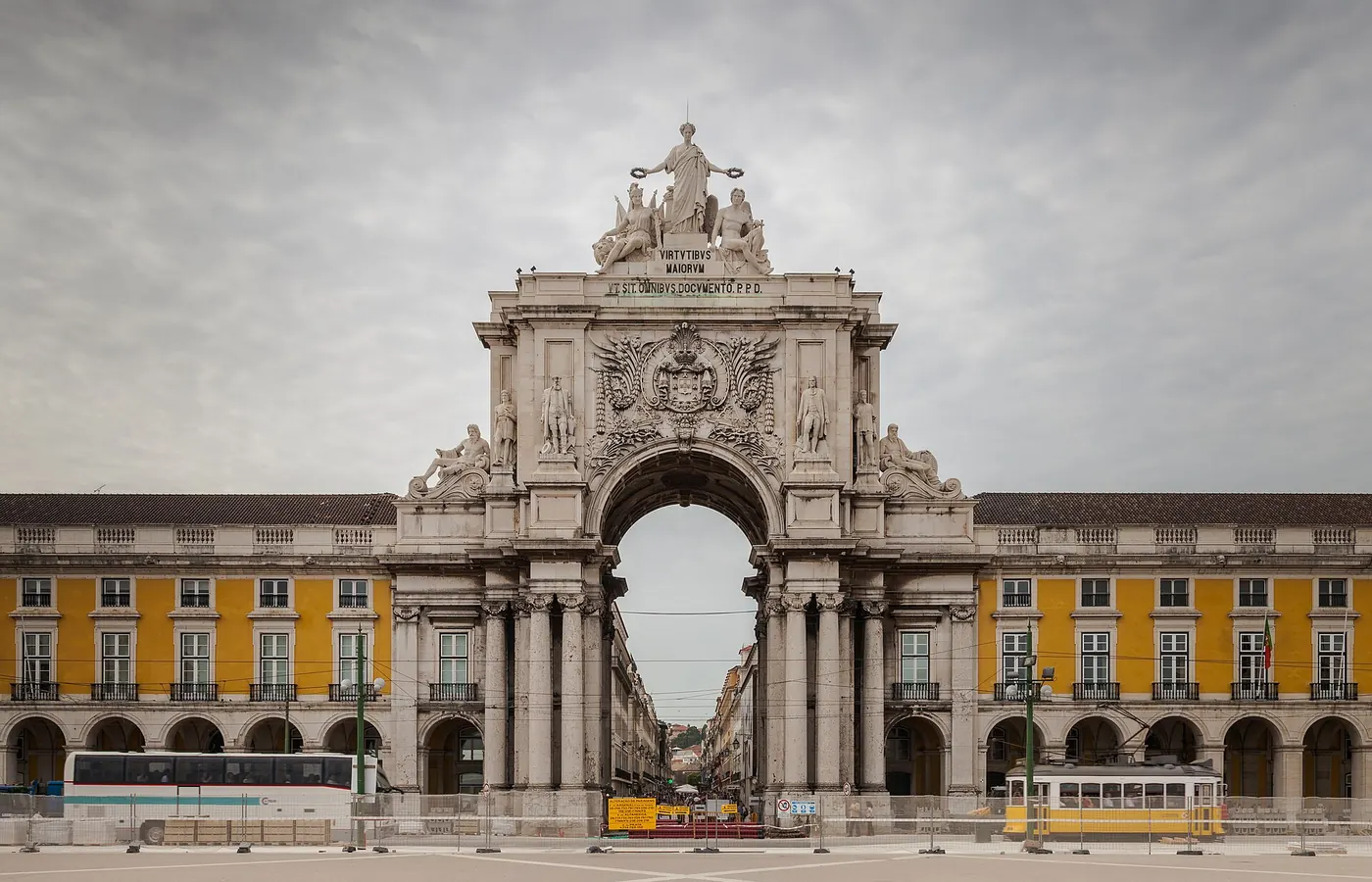
What Lisbon is known for
Portugal's capital is built across steep hills overlooking the wide estuary of the Tagus River. The city is known for its bright Atlantic light, terracotta rooftops, and historic yellow trams that navigate narrow cobbled lanes. Centuries of maritime trade have shaped its architecture, plazas, and open riverfront.
Travellers are drawn to the city's network of scenic viewpoints, known locally as miradouros, which offer broad views over red-tiled houses down to the water. Distinctive glazed ceramic tiles decorate building façades across town, while historic public squares like Praça do Comércio anchor a relaxed, walkable urban centre.
A short history
Indigenous Iberian tribes and Phoenician traders first used the Tagus estuary as a natural harbour before Roman forces established a presence in the region, naming the settlement Olisipo. Following the collapse of the Roman Empire, Germanic tribes controlled the area until Muslim forces took the city in the early 8th century, holding it for more than four centuries.
In 1147, during the Second Crusade, King Afonso Henriques captured the settlement, and by 1255 Lisbon had become the capital of the Kingdom of Portugal. During the 15th and 16th centuries, maritime expeditions departed from Lisbon's docks to Africa, Asia, and South America, transforming the city into one of Europe's wealthiest trade hubs.
A devastating earthquake, fire, and tsunami struck the capital on November 1, 1755, destroying much of the lower city and harbour area. The prime minister, the Marquês de Pombal, directed a rapid rebuilding project that replaced the ruined centre with an earthquake-resistant, neoclassical grid of avenues and stone buildings.
The city continued to modernize through the 19th and 20th centuries, weathering political changes, including the end of the monarchy and the peaceful Carnation Revolution of 1974. Today, visitors see a capital where medieval street patterns, 18th-century urban planning, and contemporary waterfront walkways stand side by side.
Neighbourhoods
Alfama is the oldest district in the city, climbing the slopes below the castle with steep stairways, quiet courtyards, and whitewashed houses that survived the 1755 earthquake. In the valley below sits Baixa, a grand, grid-patterned neighbourhood lined with uniform 18th-century buildings, broad pedestrian walkways, and riverfront avenues.
On the hill opposite Alfama, Bairro Alto features quiet residential lanes by day that give way to lively evening crowds, neighbouring the polished cultural and shopping district of Chiado. Farther west along the Tagus, Belém contains spacious public parks and maritime landmarks, while Príncipe Real offers leafy gardens and stately nineteenth-century architecture.
Food and drink
Local cuisine revolves around fresh seafood, with grilled sardines being a warm-weather tradition and salt cod, known as bacalhau, prepared in dozens of classic recipes like bacalhau à brás. Small plates called petiscos, cured cheeses, and crusty bread often start a meal, followed by traditional custard tarts dusted with cinnamon, called pastéis de nata. Popular beverages include strong espresso, tart cherry liqueur served in small glasses as ginjinha, and crisp, young green wine from the north.
Music, arts and culture
Fado music is deeply woven into the local culture, defined by expressive singing, acoustic guitars, and themes of longing, with roots trace back to working-class port neighbourhoods like Alfama and Mouraria. The art of decorative ceramic tiling, or azulejo, covers public walls, metro stations, and church interiors throughout the city. Cultural spaces such as the Museu Nacional do Azulejo and the Calouste Gulbenkian Museum preserve fine collections of traditional Portuguese tilework and international art.
Top things to do
Visitors often begin by walking up to Castelo de São Jorge, which crowns one of the city's highest hills and offers open ramparts looking out over the city and the river. From there, walkers can take in views from terraces like Miradouro de Santa Luzia or Miradouro da Senhora do Monte, visit the Romanesque Sé de Lisboa cathedral, and ride the historic public trams that grind up the hills.
A visit along the riverbank in Belém leads to the ornate Jerónimos Monastery, the fortified Belém Tower standing in the water, and the Monument to the Discoveries. Back in the lower city, the iron tower of the Elevador de Santa Justa carries passengers up between the Baixa streets and the Carmo Convent ruins.
Day trips
Sintra is an easy day trip by train into the forested hills, where travellers explore the colourful exterior of Pena Palace, the stone walls of the Castelo dos Mouros, and the grottos of Quinta da Regaleira. Along the Atlantic shoreline, the former fishing port of Cascais is a short train ride away, offering coastal walkways and sandy public beaches. Travellers with access to a car can head north within a day's drive to explore the medieval walled town of Óbidos and the ocean cliffs of Nazaré.
Before you go
Entry rules and travel advice can change. Confirm details with official sources, including the Government of Canada's advice for Portugal, before you go.
Best time to go
Spring and fall are often used for hill walking. Summers can be hot and dry, with popular viewpoints busy. Winters are mild and wetter, with short days. The city is hilly; pace yourself on steep streets and tram lines.
Getting there from Canada
Flights from Canada typically arrive at Lisbon Humberto Delgado, including some nonstops, otherwise via a European hub. Official metro and buses run from the airport into the city. Trams, steep walks and elevadores cover the historic hills.
Official travel advice
Read the Government of Canada's Portugal travel advice before you go. Rules and conditions can change.
Search flights, cars, tours and airport rides under Plan your trip below. Checkout is on the partner's site.