
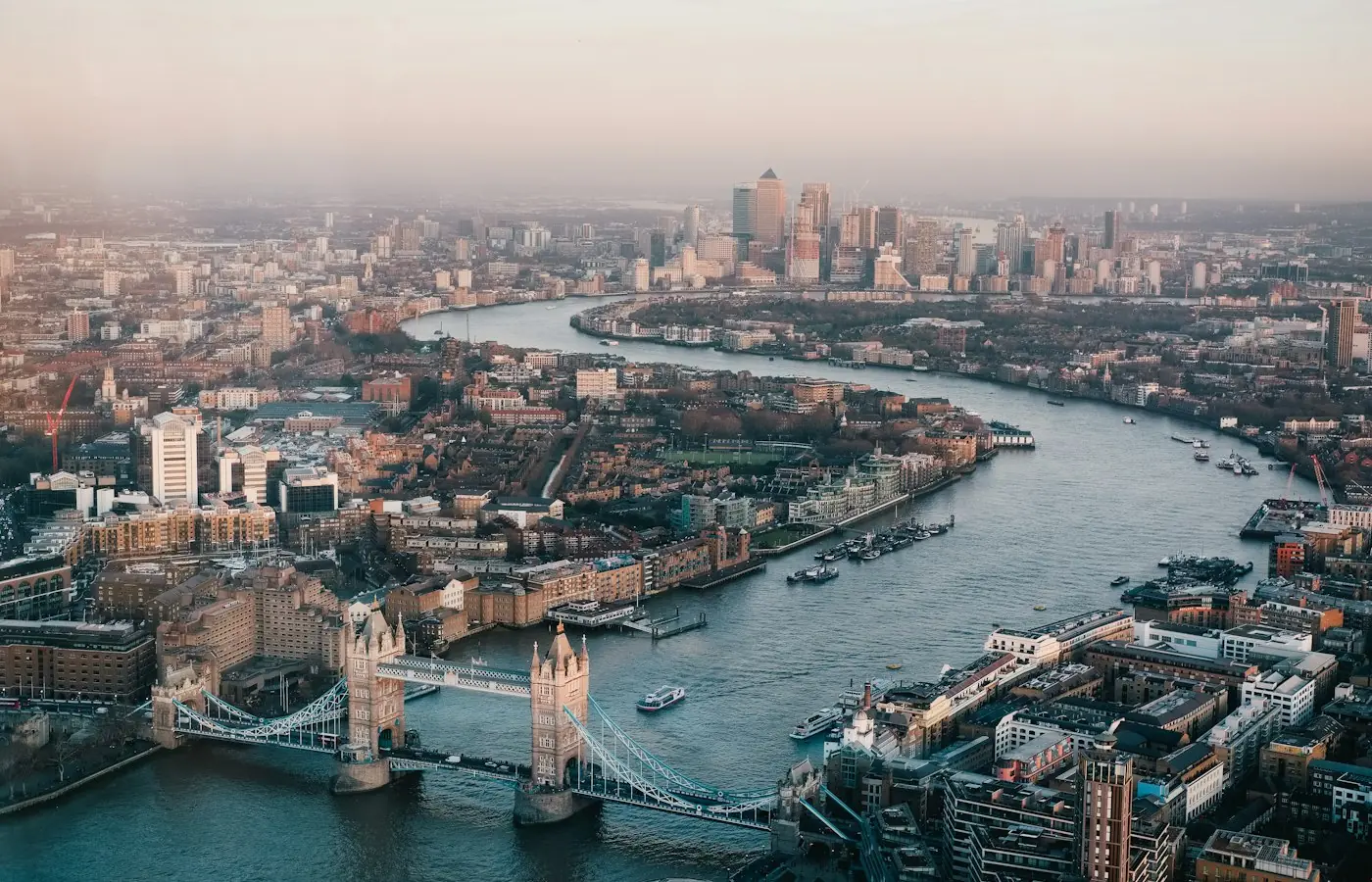
What London is known for
London is defined by its winding River Thames, expansive royal parklands, and deep layers of architecture spanning two millennia. Visitors are drawn to its collection of national museums, grand historic palaces, and the everyday rhythm of red double-decker buses crossing historic bridges.
Rather than feeling like a single concrete metropolis, the city functions as a network of distinct villages that grew together over centuries. Leafy garden squares, residential mews, and busy high streets provide quiet corners alongside major theatre districts and international financial hubs.
A short history
Settlement clustered around the Thames in prehistoric times, but the city formally began as Londinium, a Roman trading settlement established around the middle of the first century. The Romans built defensive walls, a bridge over the river, and roads that cemented the post as a major commercial port.
Following the Norman Conquest in 1066, William the Conqueror built the Tower of London to protect the river approach and secure royal authority, while Westminster emerged as the political centre. The city grew rapidly through commerce, surviving severe outbreaks of plague and the Great Fire of 1666, which destroyed most of the wooden medieval core and led to extensive rebuilding in brick and stone.
The nineteenth-century Victorian era turned London into the world's most populous city and the administrative seat of the British Empire. Engineers reshaped urban life with the construction of the world's first underground railway, extensive brick sewage networks, and vast central railway stations.
Heavy aerial bombardment during the Second World War damaged broad sections of the city, spurring post-war reconstruction that mixed modern architecture with surviving historic terraces. Successive waves of migration from Commonwealth nations and across the globe in the twentieth century broadened London's cultural makeup and shaped the global city seen today.
Neighbourhoods
Central districts such as Westminster and the West End house the core of national government, grand avenues, and historic open spaces like Trafalgar Square. Just to the east lies the City of London, where medieval church towers and Roman ruins stand against glass office towers. Across the river, the South Bank offers a long pedestrian promenade lined with public arts complexes and open river views.
Outer central neighbourhoods each carry distinct identities. Kensington and Chelsea feature formal residential squares, mews streets, and classic white-stucco terraces. In north London, Camden is recognized for its lockside markets and long-standing music scene, while eastern districts like Shoreditch and Hackney centre on converted industrial warehouses, street art, and independent creative workshops.
Food and drink
London's traditional food culture is built around classic comfort dishes such as battered fish and chips served with mushy peas, full English breakfasts, and Sunday roasts complete with Yorkshire puddings and rich gravy. Working-class markets have sustained long histories of savoury meat pies, jellied eels, and salt beef sandwiches on rye. Neighbourhood public houses, or pubs, remain central to community life for cask ales and ciders, while the tradition of afternoon tea with warm scones, clotted cream, and fruit jam continues across the city.
Music, arts and culture
The city has played a major role in shaping global music, from the rise of British rock and punk in historic gig venues to contemporary genres like grime and UK garage. The West End theatre district presents classic drama, new writing, and long-running commercial musicals, while major opera and orchestral performances fill historic halls like the Royal Albert Hall and the Royal Opera House. Literary connections run through every borough, tied to the lives and writings of figures such as Charles Dickens, Virginia Woolf, and Geoffrey Chaucer.
Top things to do
A walk along the river between Westminster Bridge and Tower Bridge takes visitors past major landmarks, including the Houses of Parliament, Big Ben, St Paul's Cathedral, and the Tower of London. Renowned cultural institutions such as the British Museum, the National Gallery, and Tate Modern welcome travellers with vast collections of international art and world history.
Expansive green spaces provide open-air retreats in the heart of the city. Stroll through Hyde Park, Kensington Gardens, or Regent's Park, or climb Parliament Hill on Hampstead Heath for sweeping skyline views. Visiting historic street markets such as Borough Market, Portobello Road Market, or Columbia Road Flower Market gives a grounded look at local daily trade.
Day trips
Historic towns and royal estates surrounding the capital are easily visited by public rail. A short train ride west brings travellers to Windsor Castle, an ancient royal fortress on the Thames, or to the university city of Oxford with its centuries-old college quadrangles and libraries. The southern coast and the pebble beach of Brighton make a straightforward seaside journey, while the Georgian crescents and preserved Roman Baths of Bath are reachable as an easy day trip.
Before you go
Transit, hours and seasonal closures should be checked with official sources before you go.
Best time to go
Late spring through early fall is the usual outdoor season; summer days are long. Winters are mild compared with much of Canada, but they are damp, windy and dark in late afternoon. Rain is possible in any month.
Getting there from Canada
Flights from Canada typically arrive at Heathrow, Gatwick, Stansted, Luton or London City, including non-stops from several Canadian cities to Heathrow and sometimes Gatwick. Heathrow has the best public-transport links into the centre (the Elizabeth line, the Underground and coaches).
Official travel advice
Read the Government of Canada's United Kingdom travel advice before you go. Rules and conditions can change.
Search flights, cars, tours and airport rides under Plan your trip below. Checkout is on the partner's site.