
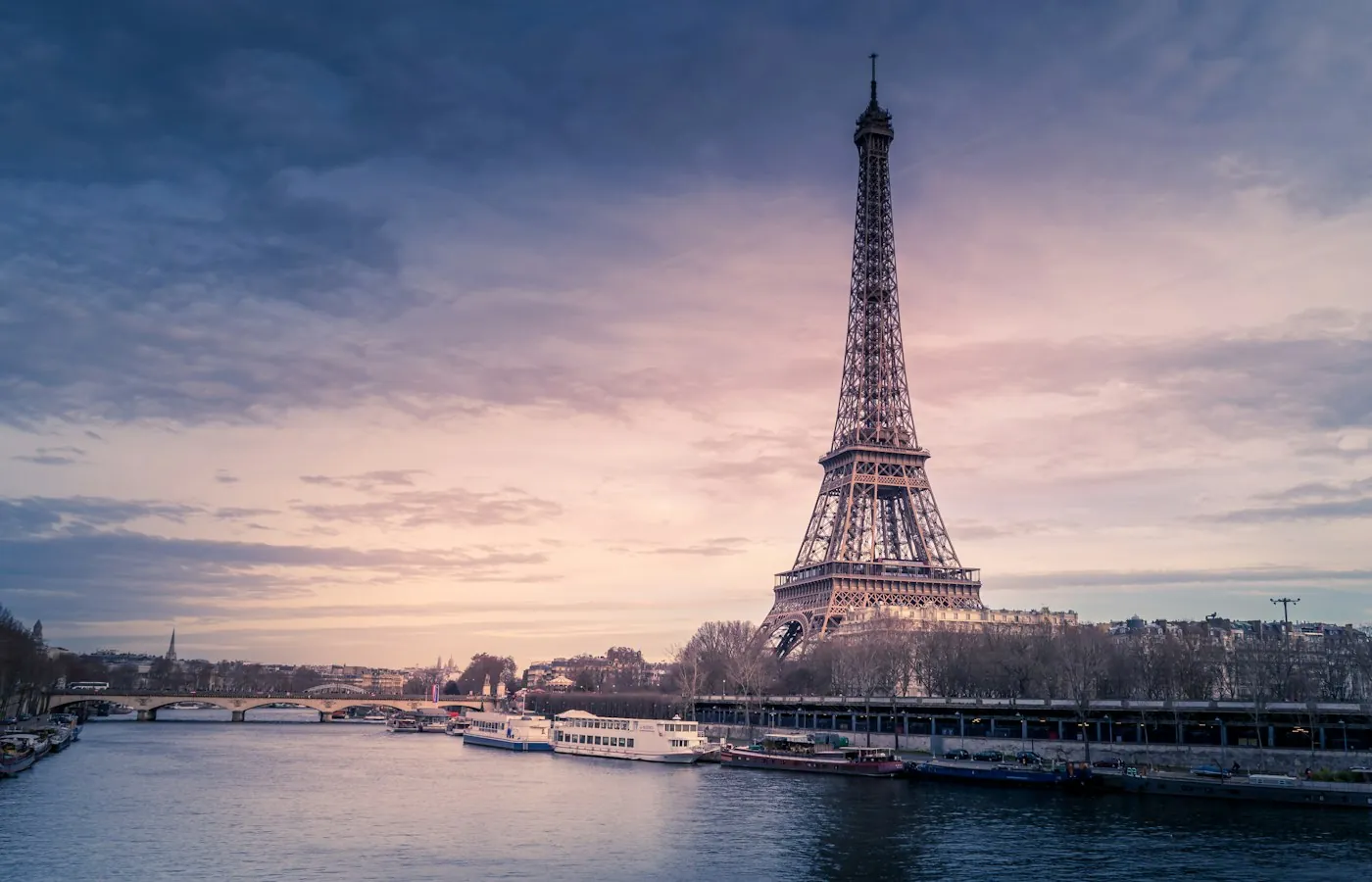
What Paris is known for
Paris is known for its walkable streetscapes, the winding course of the Seine, and a dense concentration of public art and architecture. The French capital is organized around historic stone quays, tree-lined boulevards, and public squares that encourage exploration on foot. Its human scale makes it easy to navigate across river bridges and along neighbourhood passages.
Travellers come to wander between distinct quarters, browse open-air bookstalls along the river, and spend quiet afternoons in historic public gardens. The rhythm of daily life—pausing on park chairs, watching passersby from sidewalk terraces, and admiring centuries of urban design—defines the city as much as its well-known monuments.
A short history
The Parisii, a Celtic people, settled along the banks and islands of the Seine in the third century BC. Roman forces conquered the settlement in 52 BC, developing the Roman town of Lutetia on the river's Left Bank and on the Île de la Cité. The settlement gradually adopted the name of its early inhabitants as it expanded into an active trade crossing.
By the late 10th century, Paris had become the capital of the Kingdom of France. During the Middle Ages, major academic institutions took root on the Left Bank, and master masons erected Gothic landmarks including the cathedral of Notre-Dame and the Sainte-Chapelle. The city continued to expand across the Renaissance and through the reigns of Bourbon monarchs, who constructed stone bridges, civic squares, and palatial residences.
The French Revolution of 1789 altered the country's social and political landscape, shifting power away from absolute monarchy. In the mid-19th century, Emperor Napoleon III and civic planner Georges-Eugène Haussmann modernized the urban core, replacing cramped medieval passages with wide avenues, unified cream-coloured limestone apartment buildings, and public parks that still define the centre today.
Neighbourhoods
Paris is divided into twenty numbered administrative districts, known as arrondissements, which curl clockwise outward from the centre like a snail shell. Central quarters such as the Marais feature narrow lanes, historic courtyard mansions, and active pedestrian streets, while the Latin Quarter and Saint-Germain-des-Prés retain an intellectual atmosphere shaped by centuries of university life and publishing houses.
To the north, the elevated hill of Montmartre preserves a village-like layout of cobblestone lanes, steep stairways, and broad views over the city rooftops. Farther east, the areas surrounding the Canal Saint-Martin and the 11th arrondissement offer a quieter, residential view of Paris, where locals gather beside lock gates, shaded paths, and neighbourhood market corridors.
Food and drink
Parisian food culture centres on regional staples, seasonal open-air markets, and well-established culinary routines. Daily sustenance often begins with fresh bread and butter pastries from neighbourhood bakeries, followed by classic bistro dishes like steak frites, French onion soup, roasted chicken, and cheese boards featuring varieties such as Comté and Brie. Wine from surrounding French regions commonly accompanies midday and evening meals, while afternoon pauses typically involve an espresso or an aperitif taken at an outdoor café table.
Music, arts and culture
The city has long served as a major European crossroads for artists, writers, and performers, nurturing influential artistic movements from Impressionism to early modern literature and jazz. Visitors can attend classical concerts, opera, ballet, and theatre at historic venues such as the Palais Garnier and the Philharmonie de Paris, or experience smaller performances in municipal cultural centres. A long-standing tradition of public literacy is preserved along the river quays, where licensed booksellers, known as bouquinistes, trade used volumes, antique maps, and prints from dark green metal boxes mounted on the stone parapets.
Top things to do
Major public museums draw culture lovers from around the world. The Louvre displays vast collections of antiquities and European paintings inside a former royal palace, while the Musée d'Orsay presents 19th-century works in a grand former railway terminal. Nearby, the Musée de l'Orangerie features monumental water-lily canvases, and the Musée Rodin exhibits classic sculpture across tranquil landscaped grounds.
Travellers also seek out public monuments across the city, including the Eiffel Tower on the Champ de Mars, the Arc de Triomphe overlooking the Champs-Élysées, and the white-domed Basilica of Sacré-Cœur in Montmartre. Leisurely outdoor walks through the Jardin du Luxembourg, the Tuileries Garden, and along the banks of the Île de la Cité reveal the capital's historic layout at ground level.
Day trips
Several notable regional destinations make easy day trips by train. The Palace of Versailles offers a look at 17th-century royal court architecture and vast formal gardens a short train ride from the capital. Travellers can also take a short train ride to the historic royal residence and sprawling forest of Fontainebleau, visit Chartres to view its high Gothic cathedral and original stained glass, or head into Normandy to explore the house and gardens of painter Claude Monet in Giverny.
Before you go
Museum hours, transit and seasonal closures should be checked with official sources. See today's prices for stays and flights on partner sites.
Best time to go
Late spring and early fall are often comfortable for walking. Summers can be hot, with some museum and restaurant closures in August. Winters are cool, damp and quieter, with short days. Any month works if you dress for it; official holiday dates affect hours.
Getting there from Canada
Flights from Canada typically arrive at Paris-Charles de Gaulle, including nonstops from several Canadian cities, and sometimes at Orly. CDG is north of the city, with RER and other official rail links into the centre; Orly is south.
Official travel advice
Read the Government of Canada's France travel advice before you go. Rules and conditions can change.
Search flights, cars, tours and airport rides under Plan your trip below. Checkout is on the partner's site.