
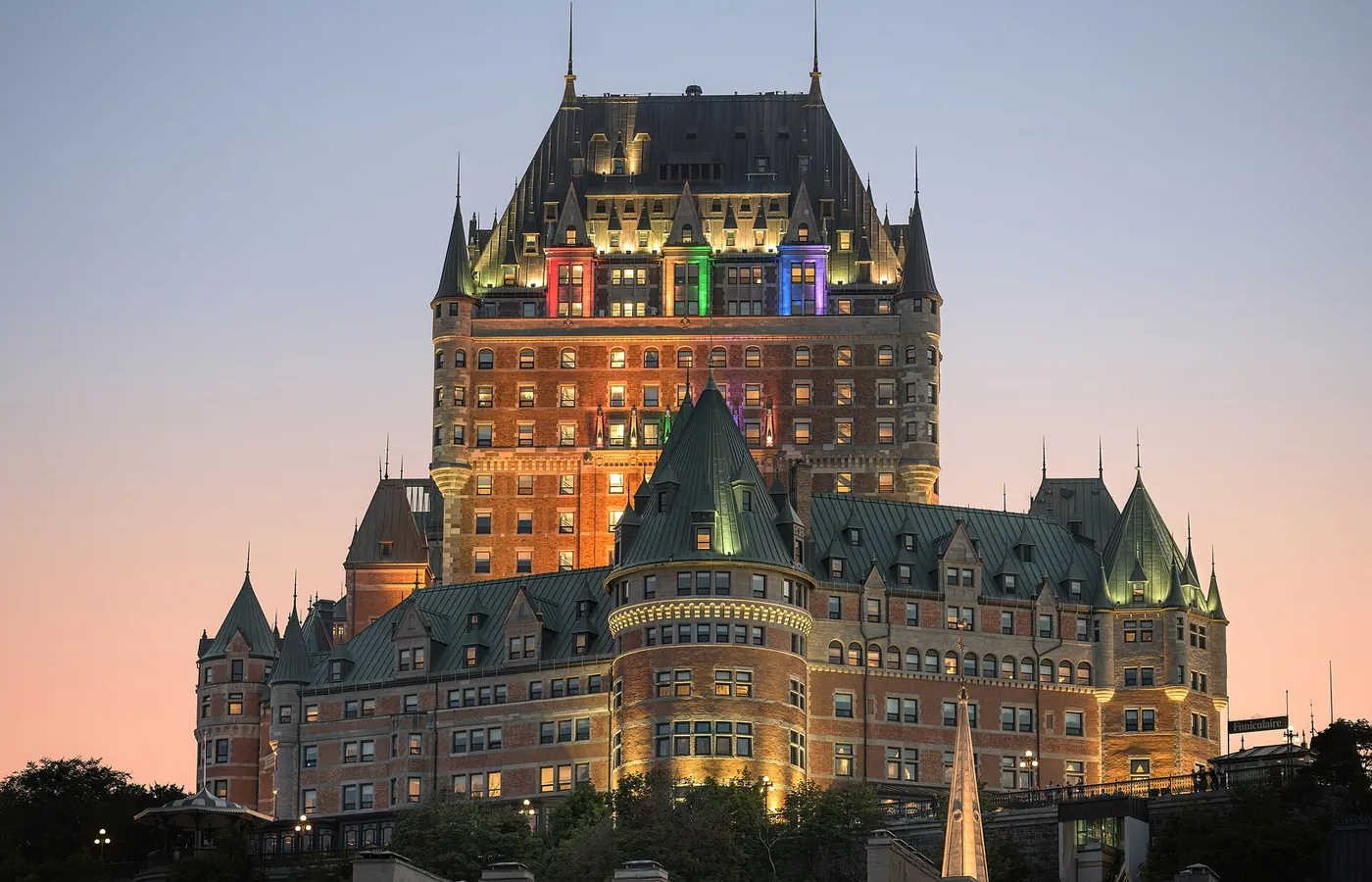
What Quebec City is known for
Quebec City sits on the cliff tops of Cap Diamant above the St. Lawrence River, where the river narrows on its path toward the Atlantic. It is known across the world for Old Quebec, the only fortified city north of Mexico with its defensive walls still intact. Stone ramparts, narrow streets, and seventeenth- and eighteenth-century architecture shape the landscape, giving the provincial capital an appearance unlike any other community in Canada.
Travellers come to walk its historic gates and promontories, take in sweeping river views, and experience the distinct French-Canadian culture of North America's oldest Francophone capital. The contrast between the elevated Upper Town and the historic Lower Town creates two distinct walking environments, both defined by centuries of maritime, military, and civic history.
A short history
Long before European arrival, the St. Lawrence Iroquoians inhabited the village of Stadacona along the riverbanks below the cliffs. In 1608, French explorer Samuel de Champlain established a permanent settlement and trading post at the base of the promontory. Champlain retained the Algonquin word Québec, meaning "where the river narrows," to name the new colony.
The settlement expanded across the heights and served as the administrative and religious capital of New France. Because of its strategic position overlooking river traffic, the settlement was heavily fortified with stone walls, gates, and artillery batteries. In 1759, British forces led by General James Wolfe defeated French troops commanded by the Marquis de Montcalm on the Plains of Abraham, leading to the Treaty of Paris in 1763 and the formal transfer of the territory to Great Britain.
Under British administration, the stone fortifications were expanded to defend against potential American incursions, culminating in the construction of the star-shaped Citadelle in the early nineteenth century. When military planners later considered demolishing the walls to accommodate urban growth, Governor General Lord Dufferin campaigned successfully in the late 1800s to preserve and restore them, shaping the historic layout seen today.
In 1985, the Historic District of Old Québec was inscribed as a UNESCO World Heritage Site in recognition of its well-preserved colonial fortifications and architecture. Today, Quebec City functions as the seat of the National Assembly of Quebec and remains the heart of French-speaking civil life in the province.
Neighbourhoods
The historic core divides into the Upper Town (Haute-Ville) and Lower Town (Basse-Ville). Upper Town sits within the stone ramparts and holds major civic landmarks, historic religious institutions, and wide pedestrian walks along Dufferin Terrace. Lower Town sits at river level and includes Place Royale, where Champlain built his first post, along with the pedestrian lanes of Petit-Champlain, connected to the upper cliffs by steep staircases and a funicular.
Beyond the historic ramparts, the city branches into lively residential and commercial quarters. Saint-Jean-Baptiste features steep side streets lined with colourful nineteenth-century row houses and local bakeries. Just west of the walls, Montcalm serves as an arts quarter along Avenue Cartier, right next to the green lawns of the Plains of Abraham. Down the hill in the Saint-Charles River valley, the Saint-Roch neighbourhood has transformed from an industrial centre into an energetic hub of independent design studios, craft breweries, and tech companies.
Food and drink
Quebec City's food culture blends classic French technique with hearty French-Canadian tradition and regional agriculture. Local favourites include tourtière (a spiced meat pie), slow-simmered pea soup seasoned with salt pork, and poutine made with fresh, squeaky cheese curds and savoury gravy. In late winter and early spring, the surrounding countryside comes alive with sugar-shack meals highlighted by pure maple syrup drizzled on snow. Regional ciders, craft beers, and farmstead cheeses from the neighbouring pastures of Charlevoix and Portneuf regularly headline city menus.
Music, arts and culture
The city maintains a strong artistic identity rooted in its French language, performing arts, and seasonal celebrations. The Musée national des beaux-arts du Québec showcases centuries of historic and modern Quebec art across pavilions set in the Battlefields Park, while the Musée de la civilisation in Lower Town focuses on human history and Indigenous societies. Large public events draw residents and travellers outdoors year-round, from the snow slides and ice sculptures of the Quebec Winter Carnival to the expansive open-air summer concerts of the Festival d'été de Québec.
Top things to do
Walking the stone fortifications and visiting the Citadelle of Quebec provides an introduction to the city's military heritage, along with broad views across the river toward Lévis. A stroll down Dufferin Terrace leads past public gazebos toward the Breakneck Stairs, which descend into the cobbled avenues of Petit-Champlain. At Place Royale, visitors can see the stone facade of Notre-Dame-des-Victoires, constructed in the late seventeenth century on the site of Champlain's original habitation.
West of the stone gates, the expansive grounds of the Battlefields Park, which encompass the Plains of Abraham, offer walking and cycling paths, historical monuments, and quiet lawns. Just nearby, the Parliament Building displays ornate Second Empire architecture surrounded by public gardens honouring key figures in Quebec's history. Down on the waterfront, the Old Port offers level walking along public wharves, marina lookouts, and open river views.
Day trips
Several regional attractions make an easy day trip from the city. A short drive downriver leads to Montmorency Falls, where water cascades down a cliff face taller than Niagara Falls, accessible by wooden stairways and a suspension bridge crossing the crest. Across a bridge from the falls, Île d'Orléans offers a scenic driving loop through historic agricultural villages, orchards, vineyards, and roadside farm stands. Further east, the shrine at Sainte-Anne-de-Beaupré draws travellers to explore its towering basilica, while Jacques-Cartier National Park sits within a day's drive to the north, offering glacial valleys, river paddling, and forested hiking trails.
Before you go
Confirm opening hours and seasonal road or ferry details with official sources before you go.
Best time to go
Summer and early fall are the usual walking seasons in the old city; fall colour in the region can be striking, though dates change. Winter is cold and snowy, and the official winter carnival dates move each year. Spring can be slushy.
Getting there from Canada
Jean Lesage International is west of the city, with flights from other Canadian hubs. VIA Rail and the road from Montreal (about three hours) are also common. The historic centre does not need a car once you are there.
Official travel advice
Travelling inside Canada does not use a country travel-advice page. Use official park, ferry and highway notices where they are mentioned above.
Search flights, cars, tours and airport rides under Plan your trip below. Checkout is on the partner's site.