
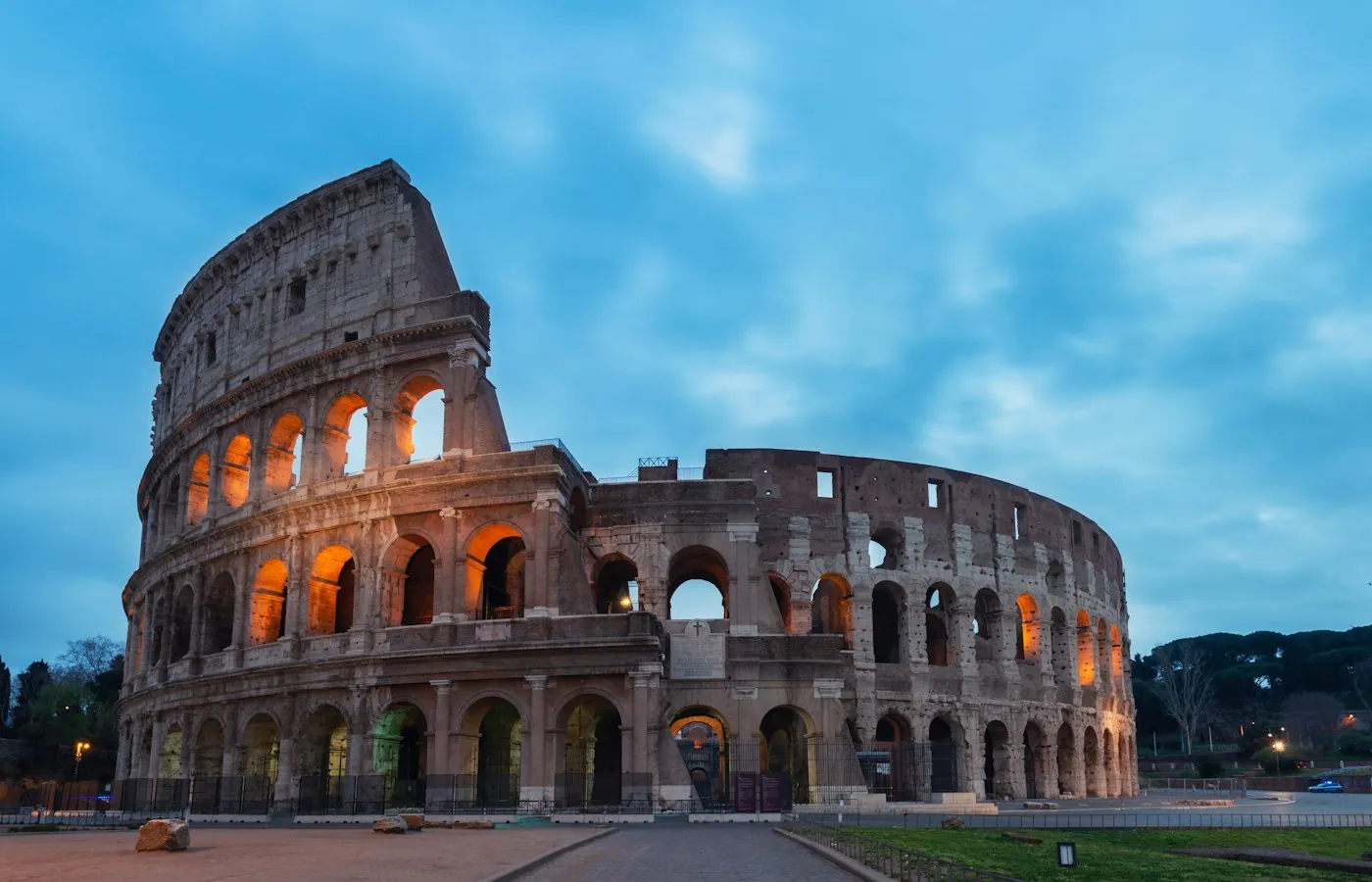
What Rome is known for
Rome is Italy's capital, defined by thousands of years of visible layers built directly into everyday urban life. Classical ruins stand alongside Renaissance palaces, Baroque fountains, and narrow paved alleys where residents carry out their daily routines.
Travellers come to wander an open-air landscape where ancient temples share street space with busy markets and open public squares. The city combines monumental architecture with an easy, unhurried street life shaped by outdoor piazzas, lively conversation, and shared meals.
A short history
Early settlements on the Palatine Hill overlooking the Tiber River date back to at least the eighth century BC, forming the basis for the traditional founding of the city. As the Roman Republic and later the Roman Empire expanded, Rome became the administrative and cultural heart of a vast Mediterranean territory, constructing monumental public works such as the Colosseum, aqueducts, and the Pantheon.
Following the decline of the Western Roman Empire, the city saw periods of political instability and population decline before rising again as the centre of the Catholic Church. During the Renaissance and Baroque eras from the fifteenth to seventeenth centuries, popes commissioned grand basilicas, expansive squares, and elaborate fountains, transforming the urban landscape into a showcase of religious and architectural power.
In 1871, Rome was declared the capital of a newly unified Italy. Modern development, government quarters, and public transit links spread beyond the ancient perimeter, while the historic centre remained remarkably intact, preserving the layered streetscape that visitors encounter today.
Neighbourhoods
The historic centre clusters around classic gathering spots like Piazza Navona, the Pantheon, and Campo de' Fiori, where pedestrians fill stone alleys and admire monumental fountains. Across the Tiber River, Trastevere offers a maze of ochre-coloured buildings, quiet residential courtyards, and lively evening piazzas that attract both locals and visitors.
Closer to the ancient ruins, Monti mixes traditional artisan workshops with small galleries and casual neighbourhood squares. Further south, Testaccio preserves strong working-class culinary traditions centred around its historic public market, while Prati, located near the Vatican, features wide nineteenth-century boulevards and quiet residential blocks.
Food and drink
Roman cooking relies on straightforward ingredients, highlighting fresh produce, pecorino romano cheese, and cured pork. Classic pasta dishes such as cacio e pepe, carbonara, and amatriciana anchor the local repertoire alongside crispy thin-crust Roman pizza and fried artichokes. Meals often conclude with a small espresso or a glass of house wine produced in the nearby Castelli Romani hills.
Music, arts and culture
The city holds centuries of artistic achievement in plain public view, from ancient Roman statuary to Renaissance frescoes by Raphael and Baroque marble works by Bernini. Major collections fill the Capitoline Museums, the Galleria Borghese, and the Vatican Museums. Classical concerts, opera, and open-air summer performances take place in historic venues across the city, including ancient outdoor settings and formal concert halls.
Top things to do
Walking through the Colosseum and the adjacent Roman Forum gives travellers a direct sense of the ancient civic core, while the nearby Palatine Hill offers views over the ruins and the Circus Maximus. A walk through the centre leads to the Pantheon, an exceptionally well-preserved temple topped by a massive unreinforced concrete dome, and the Trevi Fountain, where visitors gather in the small square.
Across the river, Saint Peter's Basilica and the Vatican Museums house landmark collections of religious art, ancient sculpture, and the Sistine Chapel. Visitors also spend time climbing the Spanish Steps, strolling through the landscaped public gardens of the Villa Borghese, or exploring the ancient catacombs located along the historic Appian Way outside the old walls.
Day trips
Several rewarding destinations lie just beyond the capital. Ostia Antica offers the excavated streets, baths, and apartment blocks of Rome's ancient harbour city, reachable on an easy day trip. In Tivoli, travellers can explore the hillside gardens and fountains of Villa d'Este along with the sprawling ruins of Hadrian's Villa, while the medieval hill towns of the Castelli Romani and the volcanic shoreline of Lake Bracciano provide relaxed countryside escapes within a short train ride or drive.
Before you go
Best time to go
Spring and fall are often the most comfortable for walking the historic centre. Summers can be very hot, with some closures in mid-August. Winters are milder than in much of Canada, with more rain and shorter days. Official public holidays affect museum hours.
Getting there from Canada
Flights from Canada typically arrive at Rome Fiumicino (Leonardo da Vinci), often via a European hub, with some nonstops in season. Ciampino is a second airport used by some carriers. Official airport rail and buses run into the city; the historic centre is then walkable, with Metro and buses for longer hops.
Official travel advice
Read the Government of Canada's Italy travel advice before you go. Rules and conditions can change.
Search flights, cars, tours and airport rides under Plan your trip below. Checkout is on the partner's site.