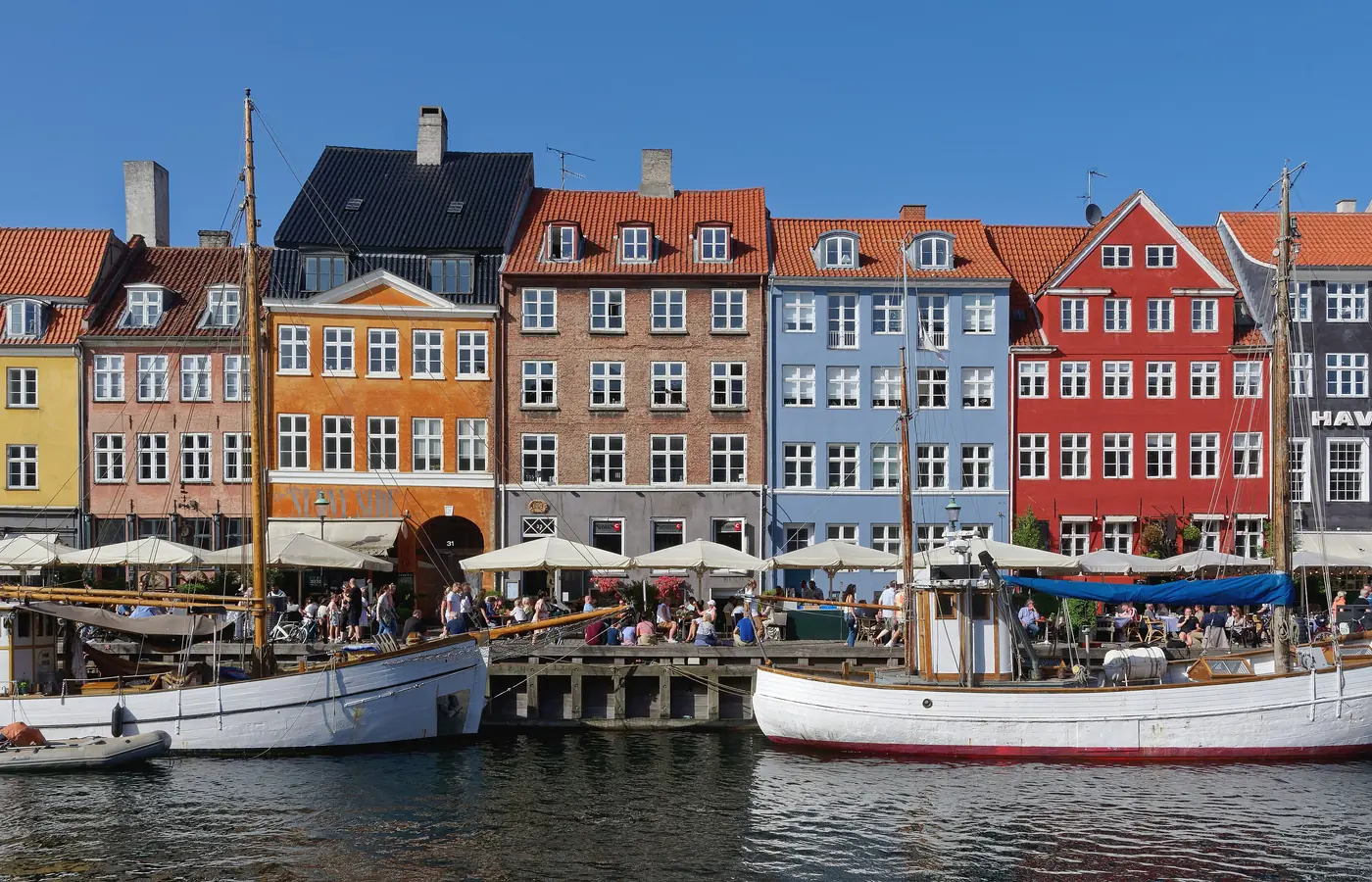
Denmark’s compact official capital: a harbour city of historic canals, Tivoli Gardens, and neighbourhoods you can walk or cycle between.
A straightforward first-visit plan: spend time at Nyhavn and along the harbour, then use official metro, buses and trains to reach another official neighbourhood. You can do the compact centre on foot and on official transit, without a car. The numbers below were taken from official pages on 25 November 2026. They can change, so confirm before you go.
The harbour, and getting around
Visit Copenhagen presents Nyhavn as one of the official harbour streets of the capital, with canals and a working waterfront beside it. That harbour stretch is where we would start. Tivoli and other official rooms use official tickets and hours, so confirm those on official pages before you go. We have not listed a Tivoli price here because a current official walk-up fare was not confirmed as a single public ticket on this check.
An official City Pass Small was 100 Danish kroner for 24 hours on 25 November 2026, or 160 kroner for 48 hours and 220 kroner for 72 hours. It covers official buses, trains, metro and light rail in zones 1 to 4, including Copenhagen Airport. You can bring two children under 12 free, and children aged 12 to 15 travel at half price. Confirm current fares on the official DOT City Pass page before you travel.
How long to stay
Two or three full days usually works, in our view, if you want the harbour, the compact centre and a little more of the city at an unhurried pace. That is our suggestion, not an official recommended length of stay. Confirm hours and tickets before you go.
Quick facts
Getting around
A car is not required for the compact centre. An official City Pass Small was 100 Danish kroner for 24 hours on 25 November 2026, including the airport in zones 1 to 4. Confirm fares before you travel.
Entry and ETIAS
Canadian citizens do not need a visa for stays of up to 90 days in any 180-day period in the Schengen area. Your passport must be valid for at least 3 months beyond the date you expect to leave the Schengen area. The Entry/Exit System is in use on arrival. ETIAS applications were not yet open (checked 19 November 2026). Confirm on travel.gc.ca before you fly.
Tivoli and official rooms
Tivoli Gardens and other official attractions use tickets and hours that change. Confirm on official pages before you go (checked 19 November 2026).
How long
Our suggestion is two or three full days for the harbour and the compact centre. Confirm hours and tickets before you go.
Areas to stay in Copenhagen
Indre By, the historic centre, or around the harbour. A walkable official core, close to the historic canals.
Christianshavn. The official canal neighbourhood named on the destination site.
Vesterbro, Nørrebro or Frederiksberg. Close-in neighbourhoods a short hop from the official harbour centre.
Some links and search tools on this page lead to partner sites, and we may earn a small commission if you book, at no extra cost to you.
Flights from Toronto typically arrive at Copenhagen Airport, Kastrup (CPH), often via a European hub, with some nonstops. Official metro and trains run from the airport into the centre. An official City Pass Small was 100 Danish kroner for 24 hours on 25 November 2026 and includes the airport in zones 1 to 4. Check the airline or the partner search above for current flights.
The compact centre can be done on foot and on official transit, without a car. Confirm current fares on the official DOT City Pass page before you travel.
Denmark is a Schengen area country. Canadian citizens do not need a visa for stays of up to 90 days in any 180-day period, and stays are cumulative across Schengen countries. Your passport must be valid for at least 3 months beyond the date you expect to leave the Schengen area. When you enter the Schengen area, the Entry/Exit System (EES) collects information about your trip as well as your facial image and fingerprints; the Government of Canada says you do not need to take any action before you travel. The European Travel Information and Authorization System (ETIAS) is an electronic travel authorization that will be required in future, but applications are not yet open (checked 19 November 2026). Apply only through the official EU website once the system is launched. Read the full Denmark travel advice before you go. Rules can change. The FAQ below also covers US visitors and other international visitors.
Search tours and tickets for the historic canals, Tivoli Gardens and official neighbourhood walks in Copenhagen.
Tours
Some links and search tools on this page lead to partner sites, and we may earn a small commission if you book, at no extra cost to you.
Compare tours, tickets and attraction passes on a partner site. Checkout happens on the partner site. Vulpeca Travel does not sell tours.
Tours
The Klook, Tiqets and Go City buttons open a general partner search, not a list limited to this destination.
Canadian citizens do not need a visa for stays of up to 90 days in any 180-day period in the Schengen area, and stays are cumulative across Schengen countries. Your passport must be valid for at least 3 months beyond the date you expect to leave the Schengen area (checked 19 November 2026). The Schengen Entry/Exit System takes a facial image and fingerprints on arrival; you do not need to do anything before you travel. ETIAS applications are not yet open. Confirm on travel.gc.ca before you fly.
If you are a US citizen: Check official entry rules for this destination, and the US Department of State's international travel information for the country. Confirm before you go (checked 25 November 2026).
If you are travelling from another country: Check this destination's official immigration or entry site, and your own government's travel advice (Canadians can start with Travel Advice and Advisories). Confirm before you go (checked 25 November 2026).
Is Malmö part of Copenhagen?
No. Malmö is in Sweden, a short official train ride across the Øresund, with its own entry rules. It is not a neighbourhood of Copenhagen.
Is a car required?
No. A car is usually a hindrance in the compact centre. Walking, official bikes and transit cover the city.
Can I book this trip on Vulpeca Travel?
No. Vulpeca Travel does not sell tickets, hotel rooms or tours. Flight, stay, car and tour tools on this page send you to partner sites, where booking and payment happen.
Weather and typical months
In the 1991–2020 record for Copenhagen, Denmark, the warmest month is July (mean 17.7 °C) and the coolest is January (mean 1.3 °C). The driest month is April (40.9 mm) and the wettest is August (75.9 mm). We do not name a single best month to visit, because that depends on what you want from the trip.
Monthly climate averages for Copenhagen, Denmark, 1991–2020
Month
Mean temperature
Precipitation
January
1.3 °C
50.6 mm
February
1.3 °C
41.7 mm
March
3.2 °C
42.7 mm
April
7.2 °C
40.9 mm
May
11.8 °C
51.4 mm
June
15.3 °C
73.1 mm
July
17.7 °C
71.7 mm
August
17.6 °C
75.9 mm
September
14.1 °C
57.5 mm
October
9.7 °C
60.8 mm
November
5.7 °C
50.3 mm
December
2.6 °C
53.5 mm
Figures are 1991–2020 monthly means of daily mean temperature (°C) and monthly precipitation (mm), from the ERA5 reanalysis retrieved through the Open-Meteo Historical Weather API on 27 November 2026. ERA5 is produced by the Copernicus Climate Change Service. These are climate averages, not a forecast. Confirm current conditions before you go.
Sources and last checked
Each source below is dated with the day we checked it. Prices, hours and rules can change. Confirm on the official site before you go.