
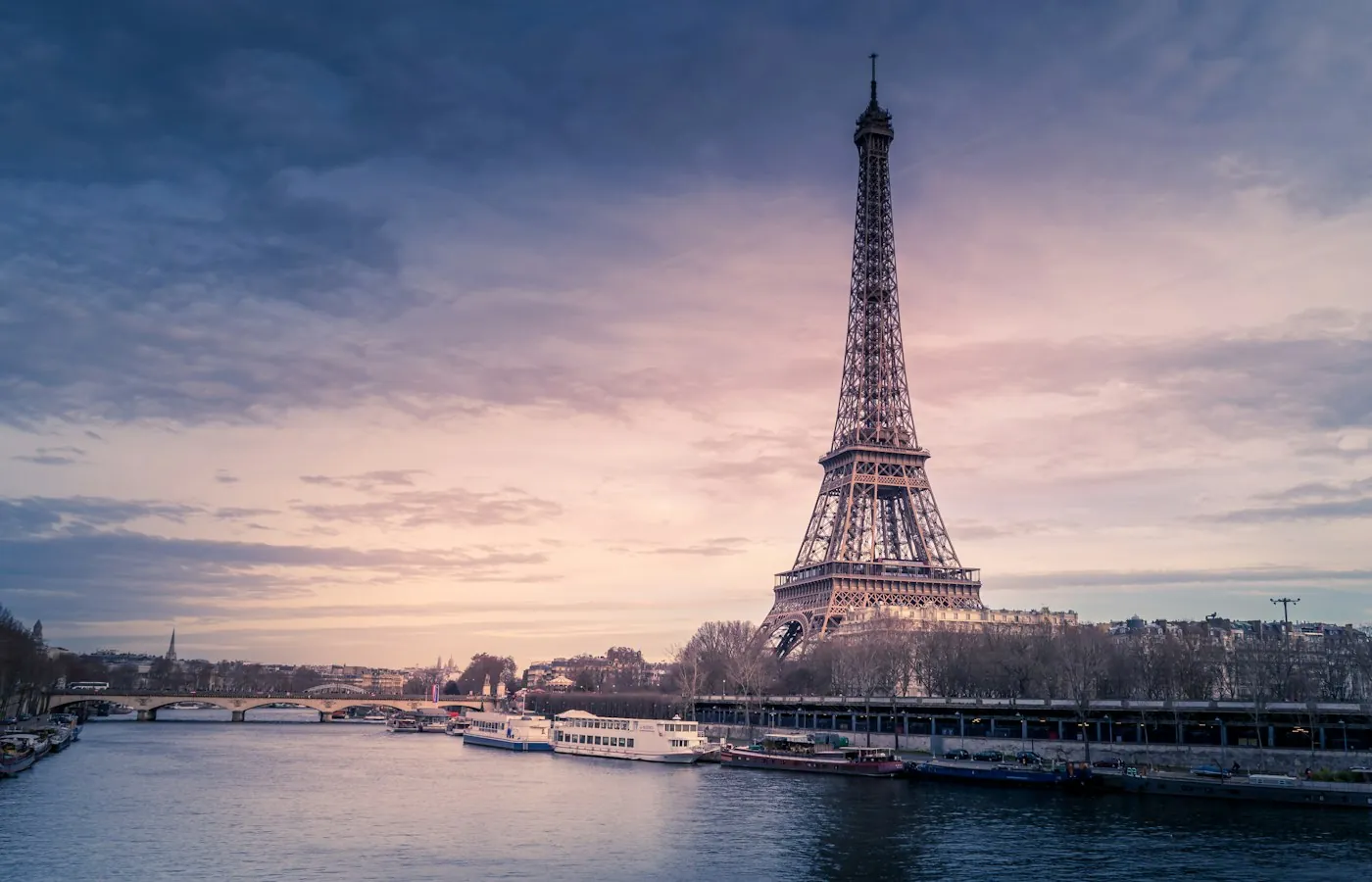
The Eiffel Tower seen from a Paris street

Destinations / Paris

Paris

A capital told from the Seine: the Louvre, Notre-Dame, the Sainte-Chapelle and the Eiffel Tower on a riverbank UNESCO has listed since 1991.

A straightforward first-visit plan: walk the banks of the Seine, go into the Louvre, and spend unhurried time in the Tuileries Garden beside it. You can do all three from a central stay, on the Metro, official rail, buses and on foot, without a car. The numbers below were taken from official pages on 25 November 2026. They can change, so confirm before you go.

The river and the Louvre

UNESCO inscribed Paris, Banks of the Seine, as a World Heritage site in 1991, and that river walk is where we would start: the Louvre, the island churches, the squares and the later tower, seen from the water. The Tuileries Garden, officially listed as free, sits beside the museum. Official garden hours in November and December were 7:30 a.m. to 7:30 p.m.

The official Louvre hours and admission page, with rates applicable as of 14 January 2026, listed a non-EEA visitor ticket at €32 and an EEA visitor ticket at €22, including the permanent collections, temporary exhibitions, and same-day or next-day entry to the Musée national Eugène-Delacroix. Visitors under 18, and EEA residents under 26, enter free, with ID. The museum is open 9 a.m. to 6 p.m. on Monday, Thursday, Saturday and Sunday, and 9 a.m. to 9 p.m. on Wednesday and Friday. It is closed on Tuesday, and on 1 January, 1 May and 25 December. Last entry is one hour before closing. Buy tickets only through the official site, and beware of unofficial sellers. Confirm hours and tickets on the official Louvre pages before you go.

Getting around, and how long to stay

The Metro, official regional rail, buses and walking cover the centre. A car is usually a hindrance inside Paris itself. Confirm current transit fares on the official Île-de-France or RATP pages before you travel.

We would allow three full days if you want the river walk, the Louvre and more of the centre at an unhurried pace. Two days can work if you keep the museum visit tightly timed. That is our suggestion, not an official recommended length of stay. Confirm hours and tickets before you go.

Quick facts

Areas to stay in Paris

  • Along the Seine, in the 1st to 7th. Closest to the official riverbank property, the Louvre, the islands and the tower side of the river.
  • The Marais, Saint-Germain or the Latin Quarter. Walkable historic neighbourhoods near the centre, with cafés and side streets as much as monuments.
  • Montmartre, Canal Saint-Martin or the 11th. A base farther out, still tied to the centre by the Métro, if you want a neighbourhood evening farther from the river.

Some links and search tools on this page lead to partner sites, and we may earn a small commission if you book, at no extra cost to you.

See hotels in Paris

You search here, then finish on the partner site, where prices and checkout appear. Vulpeca Travel does not book stays or take payment.

Search flights from Toronto

This search is pre-filled from Toronto Pearson (YYZ) to Paris Charles de Gaulle (CDG).

Some links and search tools on this page lead to partner sites, and we may earn a small commission if you book, at no extra cost to you.

Vulpeca Travel does not sell tickets. You search here, then book on the partner site, where prices and checkout appear.

Getting there from Toronto

Flights from Toronto typically arrive at Paris-Charles de Gaulle (CDG), with some services using Orly. CDG is north of the city, with official rail and other public links into the centre; Orly is south. Check the airline or the partner search above for current flights.

The Metro, official regional rail, buses and walking cover the centre. A car is usually a hindrance, not a help, inside Paris itself. Confirm current transit fares on the official pages before you travel.

France is a Schengen area country. Canadian citizens do not need a visa for stays of up to 90 days in any 180-day period, and stays are cumulative across Schengen countries. When you enter the Schengen area, the Entry/Exit System (EES) collects information about your trip as well as your facial image and fingerprints; the Government of Canada says you do not need to take any action before you travel. The European Travel Information and Authorization System (ETIAS) is an electronic travel authorization that will be required in future, but applications are not yet open (checked 27 November 2026). Apply only through the official EU website once the system is launched. Read the full France travel advice before you go. Rules can change. The FAQ below also covers other international visitors.

Search tours and tickets for the Seine, official museums and neighbourhood walks in Paris.

Tours

Some links and search tools on this page lead to partner sites, and we may earn a small commission if you book, at no extra cost to you.

Compare tours, tickets and attraction passes on a partner site. Checkout happens on the partner site. Vulpeca Travel does not sell tours.

Tours

The Klook, Tiqets and Go City buttons open a general partner search, not a list limited to this destination.

More in this region: Europe · London · Amsterdam · Barcelona · Nice · All destinations.

FAQ

Do I need a passport or a visa?

Canadian citizens do not need a visa for stays of up to 90 days in any 180-day period in the Schengen area, and stays are cumulative across Schengen countries (checked 19 November 2026). Bring a passport and follow the official validity rules on travel.gc.ca. The Schengen Entry/Exit System takes a facial image and fingerprints on arrival; you do not need to do anything before you travel. ETIAS applications are not yet open. Confirm on travel.gc.ca before you fly.

If you are a US citizen: Check official entry rules for this destination, and the US Department of State's international travel information for the country. Confirm before you go (checked 25 November 2026).

If you are travelling from another country: Check this destination's official immigration or entry site, and your own government's travel advice (Canadians can start with Travel Advice and Advisories). Confirm before you go (checked 25 November 2026).

Which airport should I use?
Paris-Charles de Gaulle (CDG) is the usual arrival airport from Toronto. Orly is a second official airport south of the city. Confirm your airline's terminal and the official rail or bus link into the centre.
Is a car required?
No. A car is usually a hindrance in central Paris. The Metro, official rail, buses and walking cover the river, the monuments and the neighbourhoods.
Can I book this trip on Vulpeca Travel?
No. Vulpeca Travel does not sell tickets, hotel rooms or tours. Flight, stay, car and tour tools on this page send you to partner sites, where booking and payment happen.

Weather and typical months

In the 1991–2020 record for Paris, France, the warmest month is July (mean 19.6 °C) and the coolest is January (mean 4.4 °C). The driest month is February (47.4 mm) and the wettest is December (67.8 mm). We do not name a single best month to visit, because that depends on what you want from the trip.

Monthly climate averages for Paris, France, 1991–2020
MonthMean temperaturePrecipitation
January4.4 °C52.4 mm
February4.8 °C47.4 mm
March7.5 °C50.6 mm
April10.5 °C50.3 mm
May14.2 °C65.5 mm
June17.4 °C58.1 mm
July19.6 °C54.3 mm
August19.5 °C57.7 mm
September16.2 °C47.9 mm
October12.3 °C60.6 mm
November7.8 °C58.6 mm
December4.9 °C67.8 mm

Figures are 1991–2020 monthly means of daily mean temperature (°C) and monthly precipitation (mm), from the ERA5 reanalysis retrieved through the Open-Meteo Historical Weather API on 27 November 2026. ERA5 is produced by the Copernicus Climate Change Service. These are climate averages, not a forecast. Confirm current conditions before you go.

Sources and last checked

Each source below is dated with the day we checked it. Prices, hours and rules can change. Confirm on the official site before you go.

If you spot something out of date, email hello@vulpecatravel.com.