
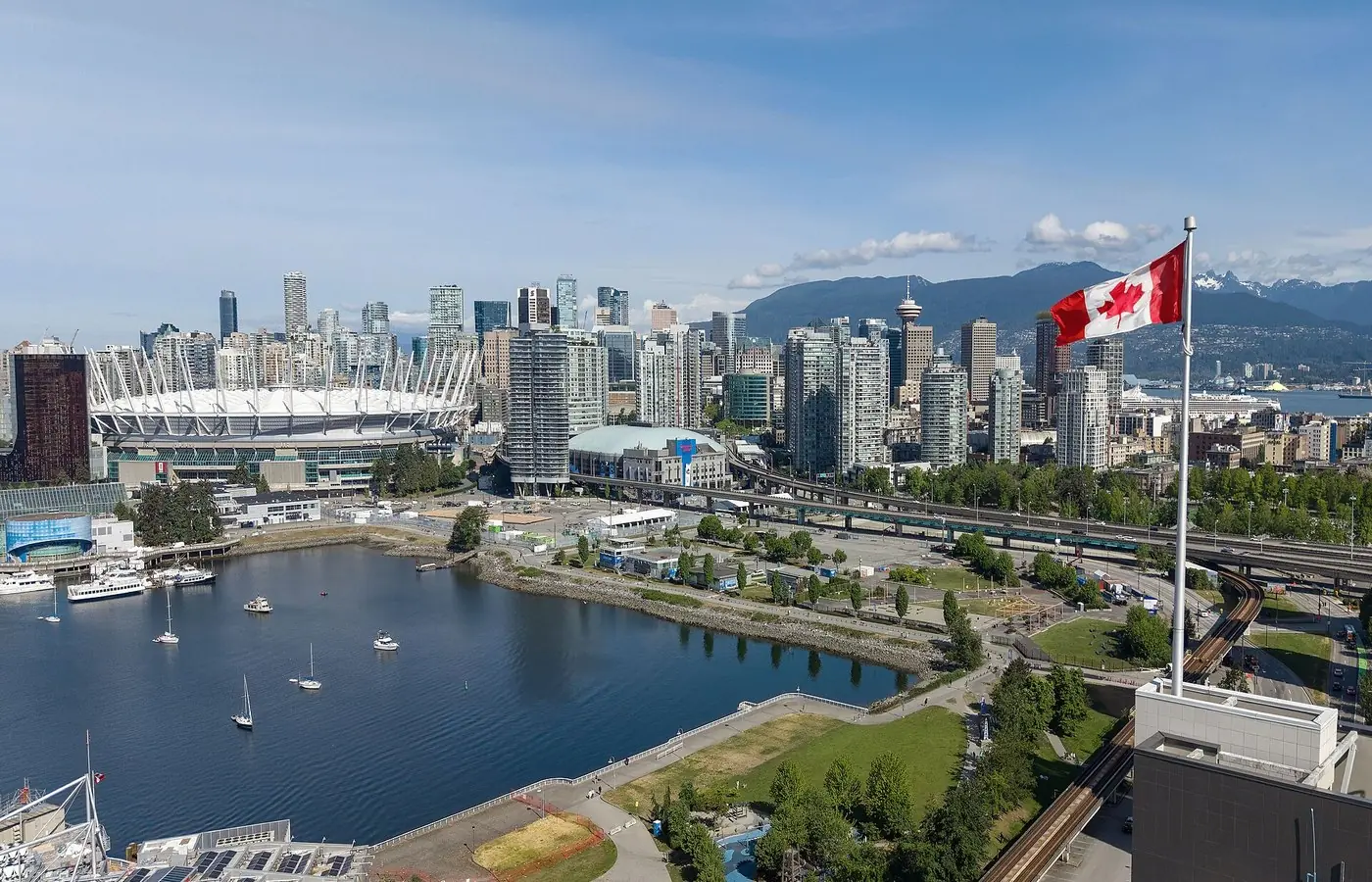
Vancouver skyline across False Creek, with mountains beyond and a Canadian flag in the foreground

Destinations / Vancouver

Vancouver

A city between trees and the tide, with Stanley Park and the seawall at its core, official neighbourhoods along the harbour, and a coastal table.

A straightforward first-visit plan: walk Stanley Park and the seawall, then cross to the North Shore for Capilano Suspension Bridge Park. You can do both from a downtown stay on TransLink, without a car. The numbers below were taken from official pages on 25 November 2026. They can change, so confirm before you go.

The park and the seawall

Destination Vancouver calls Stanley Park one of the greatest urban parks in the world, and that is where we would start. The paved seawall has separated lanes for walking and cycling, a sightseeing route along the park's coastline that locals and visitors share. Inland, quieter trails run through the centre of the park, including a loop through temperate rainforest that passes the gardens and Beaver Lake and meets the water near Third Beach. Official provincial tourism is careful to name X̱wáýx̱way, the Squamish village that was here. A stay in Vancouver can include that fact without turning the park into a theme. The trees and the wall are enough, once you know what stood among them.

Destination Vancouver, the official city tourism bureau, acknowledges the traditional, unceded territories of the xʷməθkʷəy̓əm (Musqueam), Skwxwú7mesh (Squamish) and səlilwətaɬ (Tsleil-Waututh). That is the ground the city stands on, with a harbour in front of it and mountains behind.

Capilano on the North Shore

From downtown, our second pick is Capilano Suspension Bridge Park, at 3735 Capilano Road in North Vancouver. One official day ticket covers the park's attractions, with timed entry. On 25 November 2026, the official tickets and hours page listed seasonal hours from 20 November 2026 to 10 January 2027 as 11 a.m. to 10 p.m. during Canyon Lights, with gates closing at 9 p.m., and the park closed on 25 December. Children aged 0 to 5 are free and receive their ticket on arrival. Guests under 15 must be accompanied by someone 18 or older. Park rates are subject to GST and can change, and the official page asks you to pick a date and arrival window rather than listing a single walk-up adult price, so confirm current tickets and hours on the official Capilano page before you go.

Getting around, and how long to stay

You do not need a car for downtown, the waterfront or a trip to Capilano. An adult 1-zone cash fare was $3.50 on 25 November 2026; a 2-zone cash fare was $5.10 and a 3-zone cash fare was $6.70. Paying with Compass Card stored value was $2.85 for the same 1-zone adult trip. An adult all-zone DayPass was $12.55. A single fare is valid for 90 minutes on bus, SkyTrain, SeaBus and HandyDART. After 6:30 p.m. Monday to Friday, and all day on weekends and provincial statutory holidays, trips across the system are a 1-zone fare. Confirm current fares on the official TransLink page before you travel.

Journeys starting at YVR–Airport, Sea Island Centre or Templeton include a $6.50 YVR AddFare at all times, with exemptions listed on the official TransLink transferring and AddFare page. Confirm that charge, and who is exempt, before you travel.

We would allow two full days if you want Stanley Park, the seawall and Capilano at an unhurried pace. Add a third day if you want more of the city's neighbourhoods. That is our suggestion, not an official recommended length of stay. Confirm hours and tickets before you go.

Quick facts

Areas to stay in Vancouver

  • Downtown / waterfront. Walkable to the harbour and to SkyTrain stations for trips across the city.
  • Near a SkyTrain line. Useful if you want to stay outside the core and still ride transit without a car.
  • Near the airport (Sea Island). Practical for a very early or late flight. Confirm the official YVR AddFare rules before you ride from the airport-area stations.

Some links and search tools on this page lead to partner sites, and we may earn a small commission if you book, at no extra cost to you.

See hotels in Vancouver

You search here, then finish on the partner site, where prices and checkout appear. Vulpeca Travel does not book stays or take payment.

Search flights from Toronto

This search is pre-filled from Toronto Pearson (YYZ) to Vancouver (YVR).

Some links and search tools on this page lead to partner sites, and we may earn a small commission if you book, at no extra cost to you.

Vulpeca Travel does not sell tickets. You search here, then book on the partner site, where prices and checkout appear.

Getting there from Toronto

Vancouver International Airport (YVR) is the usual arrival airport. Air Canada and WestJet list flights from Toronto to Vancouver on their official sites (checked 19 November 2026). Check the airline or the partner search above for current flights.

Downtown and the waterfront can be done without a car. TransLink SkyTrain, buses and SeaBus cover the region. Journeys starting at YVR–Airport, Sea Island Centre or Templeton include a $6.50 YVR AddFare at all times, with exemptions on the official TransLink page (checked 25 November 2026). Confirm that charge before you travel.

This is a trip inside Canada. For a domestic flight, follow the Government of Canada's pre-boarding identification requirements (checked 19 November 2026). The FAQ below also covers US visitors and other international visitors.

Search tours and tickets for Stanley Park, the seawall and the city's neighbourhoods.

Tours

Some links and search tools on this page lead to partner sites, and we may earn a small commission if you book, at no extra cost to you.

Compare tours, tickets and attraction passes on a partner site. Checkout happens on the partner site. Vulpeca Travel does not sell tours.

Tours

The Klook, Tiqets and Go City buttons open a general partner search, not a list limited to this destination.

More in this region: British Columbia · Victoria · Whistler · Tofino · Seattle · Portland · Yellowknife · All destinations.

FAQ

Do I need a passport?

If you already live in Canada and this is a trip inside the country: This is a trip inside Canada. For a domestic flight, follow the Government of Canada pre-boarding identification requirements (checked 19 November 2026). A passport is one accepted form of ID, not the only one. The name on your ID must match your ticket.

If you are a US citizen visiting Canada: The Government of Canada recommends travelling with a valid passport, and says it is the only reliable and universally accepted travel and ID document. US citizens do not need a Canadian visa or an eTA if they travel with a valid US passport. If you are not travelling by air and do not have a passport, other identity documents that show your full name, date of birth and citizenship may be accepted. Confirm on the official page before you go (checked 25 November 2026).

If you are visiting from another country: Check whether you need a visitor visa or an electronic travel authorization (eTA) on the official Visit Canada page, or use the visa or eTA checker. Most visa-exempt travellers need an eTA to fly to or transit through a Canadian airport. The official eTA application costs CAN$7. Dual Canadian citizens need a valid Canadian passport, not an eTA. Confirm before you go (checked 25 November 2026).

Is a car required?
No for downtown and the waterfront. TransLink SkyTrain, buses and SeaBus cover the region. After 6:30 p.m. on weekdays, and all weekend, trips are a 1-zone fare (checked 25 November 2026).
Is there an extra fare from the airport?
Yes, in most cases. Journeys starting at YVR–Airport, Sea Island Centre or Templeton include a $6.50 YVR AddFare at all times, with exemptions listed on the official TransLink page (checked 25 November 2026).
Can I book this trip on Vulpeca Travel?
No. Vulpeca Travel does not sell tickets, hotel rooms or tours. Flight, stay, car and tour tools on this page send you to partner sites, where booking and payment happen.

Weather and typical months

In the 1991–2020 record for Vancouver, Canada, the warmest month is August (mean 18.2 °C) and the coolest is January (mean 3.2 °C). The driest month is July (51.0 mm) and the wettest is November (337.5 mm). We do not name a single best month to visit, because that depends on what you want from the trip.

Monthly climate averages for Vancouver, Canada, 1991–2020
MonthMean temperaturePrecipitation
January3.2 °C299.1 mm
February3.9 °C187.1 mm
March5.7 °C244.3 mm
April8.5 °C168.0 mm
May12.3 °C114.0 mm
June15.0 °C91.7 mm
July18.0 °C51.0 mm
August18.2 °C71.7 mm
September15.3 °C117.3 mm
October10.3 °C237.7 mm
November5.9 °C337.5 mm
December3.2 °C298.4 mm

Figures are 1991–2020 monthly means of daily mean temperature (°C) and monthly precipitation (mm), from the ERA5 reanalysis retrieved through the Open-Meteo Historical Weather API on 27 November 2026. ERA5 is produced by the Copernicus Climate Change Service. These are climate averages, not a forecast. Confirm current conditions before you go.

Sources and last checked

Each source below is dated with the day we checked it. Prices, hours and rules can change. Confirm on the official site before you go.

If you spot something out of date, email hello@vulpecatravel.com.