
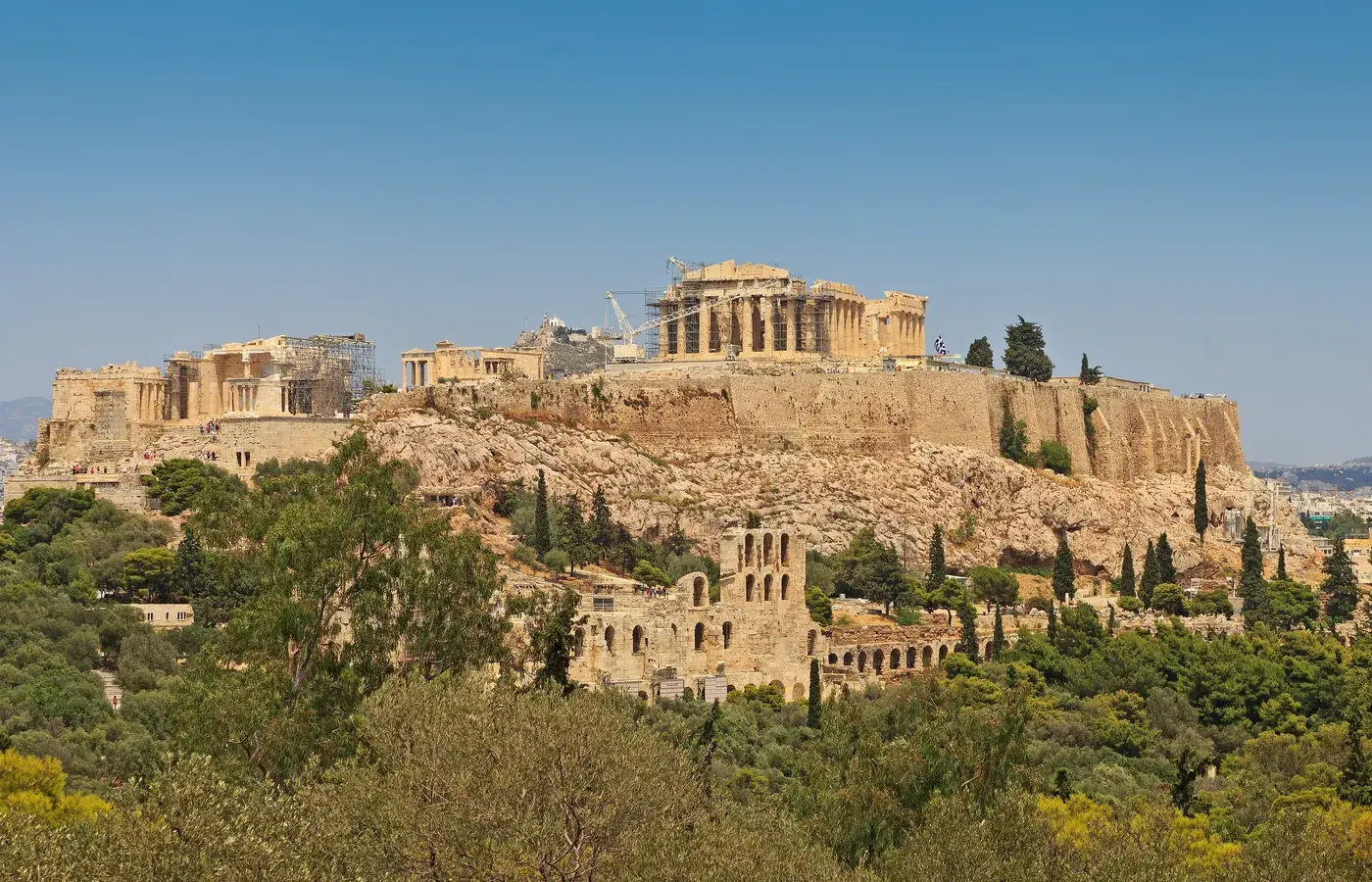
What Athens is known for
Athens is defined by the contrast between its ancient monuments and a dense, energetic modern city. Classical ruins like the Parthenon rise on limestone plateaus directly above busy transit corridors, open-air markets, and residential apartment blocks. It is a city where centuries of architecture sit side by side, creating an urban landscape shaped by classical antiquity, Byzantine traditions, and modern growth.
Travellers come to explore the origins of Western democracy, philosophy, and theatre, but they often stay for the everyday street life. The city centre rewards walking, with shaded pedestrian paths connecting ancient sanctuaries, lively public squares, and neighbourhood terraces where locals gather for coffee or dinner late into the evening.
A short history
Human settlement in the Attica basin began thousands of years ago, with evidence of Neolithic communities around the Acropolis. By the late Bronze Age, Mycenaean rulers built a fortified citadel on the hilltop, establishing a seat of power that formed the foundation for the later city-state.
In the fifth century BC, Athens entered its classical golden age under the leadership of figures like Pericles. During this era, the city introduced direct democratic rule for its citizens, built major marble temples including the Parthenon, and nurtured playwrights such as Aeschylus and Sophocles. Classical thinkers like Socrates and Plato also taught in its public spaces and philosophical academies.
The city subsequently came under Macedonian, Roman, and Byzantine authority before becoming part of the Ottoman Empire in the mid-15th century. Over the centuries, its political power declined, and by the early 19th century, Athens had shrunk to a modest settlement clustered tightly around the northern slopes of the Acropolis.
After the Greek War of Independence, Athens was declared the capital of the new kingdom of Greece in 1834. Bavarian planners commissioned wide neoclassical avenues, public parks, and monumental civic buildings, directing an expansion that gradually transformed the town into the sprawling European metropolis seen today.
Neighbourhoods
Plaka wraps around the foot of the Acropolis, characterised by narrow pedestrian streets, 19th-century houses, and small chapels. Just above it, Anafiotika features small, whitewashed cubic homes built in the 19th century by craftsmen from the Cycladic island of Anafi, giving the enclave the appearance of an island village. To the northwest, Monastiraki opens onto a bustling central square bordered by historic markets and ruins, leading into Psirri, an area known for artisan workshops, small music halls, and colourful street murals.
Syntagma acts as the administrative centre of the capital, framed by the Hellenic Parliament building and the shaded pathways of the National Garden. Kolonaki climbs the lower slopes of Mount Lycabettus with quiet residential avenues, embassies, and small galleries, while the district of Exarcheia maintains an independent spirit shaped by student life, bookshops, and political history.
Food and drink
Athenian food traditions focus on fresh ingredients and shared dishes, known as mezedes, paired with local wine, ouzo, or anise-free tsipouro. Street vendors sell koulouri, a circular bread roll coated in sesame seeds, while bakeries and kiosks offer savoury pies stuffed with spinach and feta. Traditional tavernas serve grilled meats, skewered souvlaki, and slow-baked dishes like moussaka, alongside classic Greek salads dressed with olive oil and wild oregano.
Music, arts and culture
Cultural performance has a long lineage in Athens, where ancient stone amphitheatres remain in active use. The Odeon of Herodes Atticus hosts orchestral performances, opera, and classical Greek drama beneath the illuminated Acropolis. The city also sustains rembetiko, an urban folk style played on stringed instruments like the bouzouki and baglamas, while modern art centres and grassroots galleries showcase contemporary Greek artists.
Top things to do
The Acropolis complex contains several of Greece's most famous structures, including the Parthenon, the Erechtheion, and the monumental entrance gateway, the Propylaea. Just down the slope, the Acropolis Museum displays original sculptures, friezes, and excavated ruins visible through transparent glass walkways. Nearby, the Ancient Agora preserves the Temple of Hephaestus and the Stoa of Attalos, offering insight into the civic and commercial life of ancient Athens.
Visitors looking for panoramic views can walk or take the funicular railway up Mount Lycabettus, the highest peak in the city centre. Philopappos Hill provides another network of walking paths with close-up perspectives of the Acropolis. For an overview of ancient history, the National Archaeological Museum holds thousands of artifacts from across Greece, including Bronze Age gold relics and classical bronze statues.
Day trips
At the southern tip of the Attica peninsula, Cape Sounion features the coastal Temple of Poseidon overlooking the Aegean Sea, an easy day trip along the coastline. From the port of Piraeus, travellers can take a short ferry ride to nearby Saronic islands such as Aegina or Hydra for quiet harbour walks. Farther inland on the Greek mainland, the ancient sanctuary of Delphi and the Bronze Age ruins of Mycenae both lie within a day's drive.
Before you go
Site hours and ticketing change, check official sources before you go. For travel advice, start with the Government of Canada's Greece travel advice.
Another Greece starting point on this site is Santorini. See also Rome.
Best time to go
April, May, September and October are often the most comfortable for climbing the Acropolis. Midsummer can be very hot, with official heat notices sometimes changing archaeological-site hours. Winters are milder than in much of Canada, with more rain.
Getting there from Canada
Flights from Canada typically arrive at Athens International (Eleftherios Venizelos), usually via a European hub, with some seasonal nonstops. Official metro and buses run into the city. The historic centre is then compact and walkable, though hills and heat matter.
Official travel advice
Read the Government of Canada's Greece travel advice before you go. Rules and conditions can change.
Search flights, cars, tours and airport rides under Plan your trip below. Checkout is on the partner's site.