
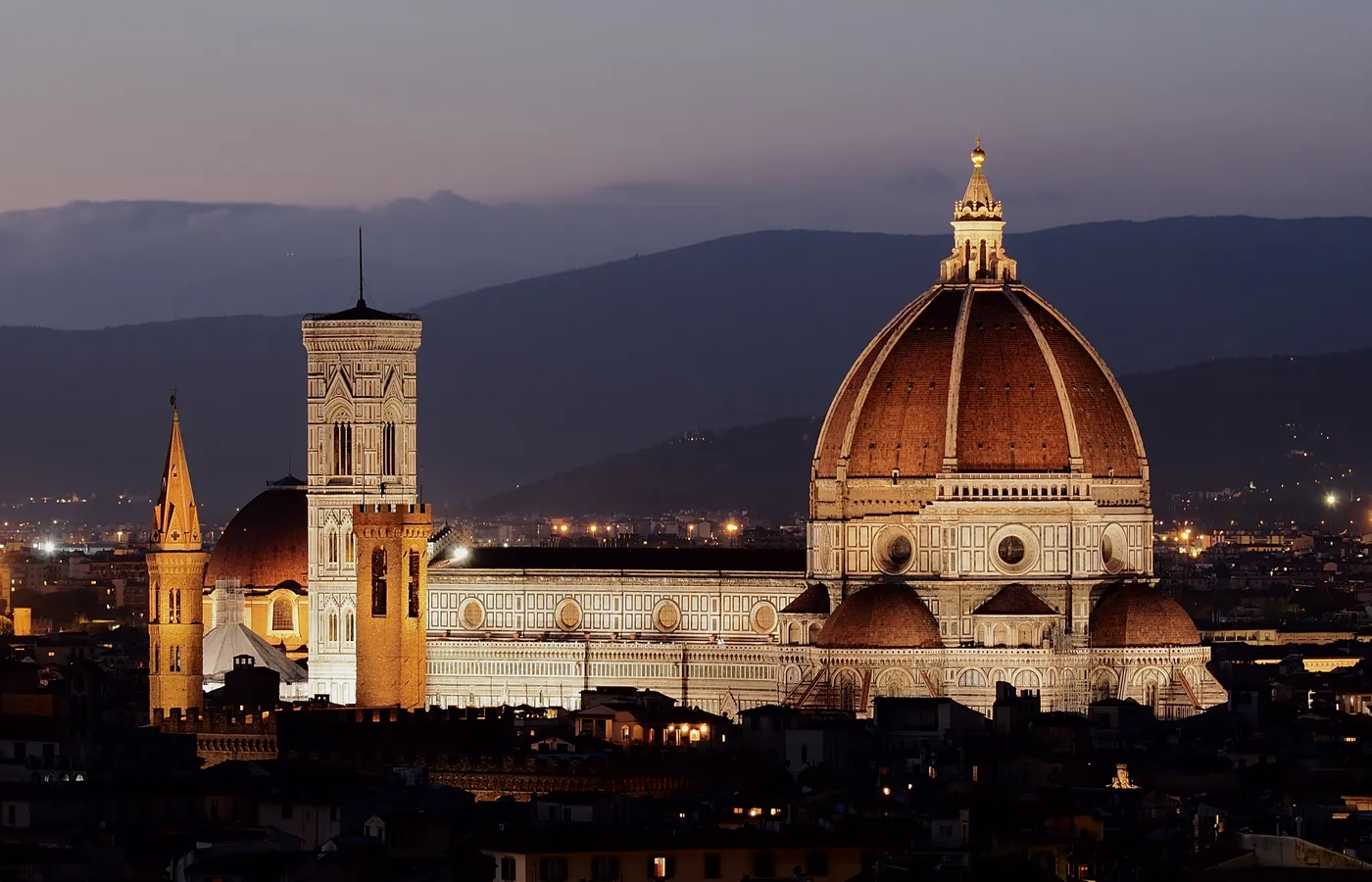
What Florence is known for
Florence is celebrated as the birthplace of the Italian Renaissance. Set along the Arno River, the Tuscan capital is defined by terracotta rooftops, stone bridges, and the distinctive red-tiled dome of its cathedral. Travellers visit to experience centuries of artistic innovation, classical architecture, and civic history preserved in an accessible urban setting.
The historic centre is remarkably compact, allowing visitors to walk from medieval lanes to grand public squares with ease. The city balances a deep artistic legacy with daily market life, riverside promenades, and scenic viewpoints looking out across the surrounding Tuscan hills.
A short history
The Arno valley was originally settled by Etruscans before Roman forces established a military colony known as Florentia in the first century BC. Laid out in a classic grid pattern, the settlement grew steadily as a commercial hub along trade and river routes through central Italy.
By the late medieval period, Florence had become an independent republic and a powerhouse of international trade and banking. Wealth generated from wool production and finance allowed leading families, most notably the Medici, to support artists, architects, and scholars. Figures such as Brunelleschi, Donatello, and Michelangelo helped drive the Renaissance, transforming European culture.
Florence later served as the capital of the Grand Duchy of Tuscany and briefly as the capital of a newly unified Italy in the late 1860s. Although modernized over the centuries, the city retained the historic core that travellers explore today.
Neighbourhoods
The historic centre revolves around Piazza del Duomo and Piazza della Signoria, where stone palaces and pedestrian avenues remain active with visitors and street life. East of this central area lies Santa Croce, a neighbourhood known for its expansive church square, traditional leather workshops, and casual evening gathering spots.
Across the Arno lies the Oltrarno district, which preserves a traditional artisan atmosphere. In quarters such as Santo Spirito and San Frediano, travellers will find woodworkers, bookbinders, and leafy public squares where residents gather at outdoor tables against historic facades.
Food and drink
Florentine cuisine is hearty and rooted in Tuscan peasant traditions, focusing on simple ingredients prepared with care. Classic dishes include bistecca alla fiorentina, a thick T-bone steak grilled over hot coals, and ribollita, a slow-cooked vegetable, bean, and bread stew. Street food culture centres on lampredotto, a sandwich made from stewed tripe served on a crusty roll with herb sauce. Meals are traditionally accompanied by local red wines such as Chianti, produced from Sangiovese grapes grown in the nearby Tuscan hills.
Music, arts and culture
Florence played an important part in the birth of opera in the late 16th century through the work of the Florentine Camerata, a group of local humanists, poets, and musicians. Today, the city maintains that musical tradition through performances at the Teatro del Maggio Musicale Fiorentino and in historic churches across town. Visual arts remain central to civic life, with world-class collections at public galleries complemented by outdoor film screenings and craft traditions that have continued for centuries.
Top things to do
A walk through the centre takes in some of Italy's finest civic and religious landmarks. The Cathedral of Santa Maria del Fiore, featuring Filippo Brunelleschi's vast dome, anchors the skyline alongside Giotto's Campanile and the Baptistery of San Giovanni. Nearby, the Uffizi Gallery holds major works by Botticelli, Leonardo da Vinci, and Raphael, while the Galleria dell'Accademia houses Michelangelo's marble statue of David.
Crossing the historic Ponte Vecchio, lined with traditional jewellers' shops, leads to the south bank of the Arno. Here, visitors can explore the terraced Boboli Gardens behind the Pitti Palace or walk up to Piazzale Michelangelo for sweeping views across the river and the city's tiled roofs.
Day trips
Florence serves as a practical base for exploring the wider region of Tuscany. A short train ride west brings travellers to Pisa to view its cathedral complex and bell tower, or to Lucca, encircled by intact Renaissance ramparts. A short train ride south reaches Siena, known for its fan-shaped Piazza del Campo and medieval brick buildings. For rural scenery, the Chianti wine area is an easy day trip, offering quiet country roads, olive groves, and hillside vineyards.
Before you go
Hours and ticket rules for the cathedral, galleries and other sites change, check official sources before you go. For travel advice, start with the Government of Canada's Italy travel advice.
Other Italy starting points on this site include Rome and Venice.
Best time to go
Spring and fall are often used for walking the compact centre. Summers can be hot and busy. Winters are cooler and quieter, with more chance of rain. Official holiday hours apply to civic museums.
Getting there from Canada
Flights from Canada usually reach Florence via a European hub, into Florence Airport (Peretola) or, as often, into Pisa with a train onward. The historic centre is small and is best walked; cars are restricted in the official ZTL traffic zone.
Official travel advice
Read the Government of Canada's Italy travel advice before you go. Rules and conditions can change.
Search flights, cars, tours and airport rides under Plan your trip below. Checkout is on the partner's site.