
What Venice is known for
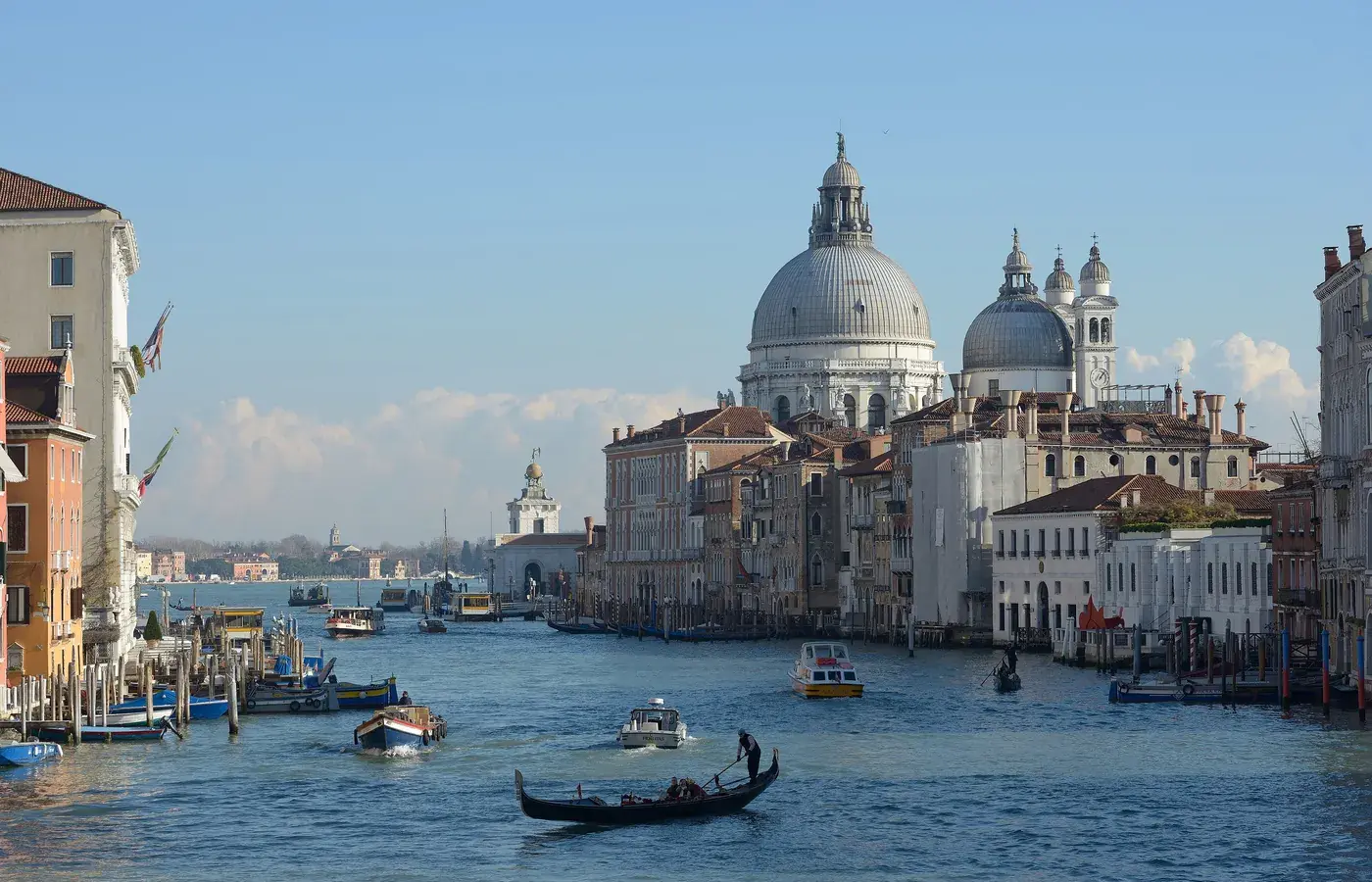
Built across more than a hundred small islands in a shallow Adriatic lagoon, Venice replaces paved roads with open water. The city is known for its intricate network of canals, stone footbridges, and Gothic and Renaissance architecture rising directly from the waterline.
Travellers come to experience a historic centre free from cars and buses, where daily movement happens on foot, by water bus, or by gondola. The Grand Canal forms the main artery, lined with marble-fronted palaces that reflect centuries of international trade and maritime dominance.
A short history
The settlement of the Venetian lagoon began in late antiquity, when inhabitants of nearby Roman mainland settlements sought refuge from invading armies. Small communities gathered on marshy islands like Torcello and Malamocco, subsisting on fishing and salt extraction before shifting toward the Rialto islands.
Over the medieval era, the Republic of Venice grew into a naval and commercial power. Governed by an elected doge and councils of merchants, the state built a massive shipyard known as the Arsenale, establishing trading networks that stretched throughout the Mediterranean and into the Levant.
The Republic's commercial monopoly waned after Portuguese and Spanish navigators opened oceanic trade routes to Asia and the Americas. In 1797, French troops under Napoleon Bonaparte entered the city, ending more than a thousand years of independence. Venice changed hands between Austria and France before joining unified Italy in 1866.
Because modern industrial development concentrated on the mainland in the 19th and 20th centuries, the historic island city retained its original urban layout. Today, the lagoon and its architectural heritage are preserved as a collective UNESCO World Heritage site.
Neighbourhoods
Venice is organized into six historic districts known as sestieri. San Marco is the ceremonial core, home to the main public square and major civic landmarks. Across the Grand Canal, San Polo and Santa Croce offer traditional fruit and fish markets alongside quiet residential alleys, while Cannaregio to the north includes the historic Jewish Ghetto, established in 1516, and wide, peaceful waterways.
To the south, Dorsoduro has an open feel with its sunny waterfront promenade along the Giudecca Canal and several university buildings. East of the centre, Castello spreads toward the expansive Arsenale basins and public parklands, where visitors encounter laundry lines strung between buildings and neighbourhoods lived in by local residents.
Food and drink
Venetian food relies heavily on lagoon seafood and vegetables grown on the sandy barrier islands. Locals gather before dinner for cicchetti, which are small savoury bites served with a small glass of wine. Common specialities include baccalà mantecato (whipped salt cod served on grilled polenta), sarde in saor (sweet-and-sour sardines preserved with onions, raisins, and pine nuts), and risotto coloured with cuttlefish ink. Thinly sliced calf's liver cooked slowly with onions, known as fegato alla veneziana, is another regional standard, often paired with sparkling Prosecco from the nearby hills of Veneto.
Music, arts and culture
The city has made significant contributions to Western art and music. Renaissance masters such as Titian, Tintoretto, and Veronese decorated its churches and guildhalls with dramatic canvases that remain on public view. In classical music, composer Antonio Vivaldi taught and wrote many of his concertos in Venice, and Teatro La Fenice continues to stage opera in an ornate auditorium rebuilt after fires. Venice also remains a fixture of the modern cultural calendar through the Venice Biennale, which features international contemporary art and architecture, alongside the annual Venice International Film Festival on the Lido.
Top things to do
Piazza San Marco is the central gathering place, framed by the arcades of the Procuratie and St. Mark's Basilica, which is renowned for its Byzantine domes and gold-leaf interior mosaics. Beside the basilica, the Doge's Palace features grand council chambers, decorated ceilings, and the covered Bridge of Sighs leading to the historic prison cells.
A ride on a vaporetto (water bus) down the Grand Canal provides views of landmarks like the Ca' d'Oro palace and the Santa Maria della Salute church. Travellers can cross the Rialto Bridge to browse the public fish and produce stalls, climb the Campanile di San Marco for views across the lagoon, or take water excursions to Murano for glass workshops and Burano for colourful fisherman cottages.
Day trips
The mainland region of Veneto holds several rewarding destinations that are accessible from the island terminals. Padua is a short train ride away, home to Giotto's 14th-century frescoes in the Scrovegni Chapel and one of the world's oldest university botanical gardens. Vicenza, also an easy day trip by rail, features classical palaces and the Olympic Theatre designed by Renaissance architect Andrea Palladio. Further west, Verona offers a remarkably intact Roman amphitheatre and a walkable medieval historic centre.
Before you go
Acqua alta (seasonal high water), ferry schedules and site hours change, check official sources before you go. For travel advice, start with the Government of Canada's Italy travel advice.
Other Italy starting points on this site include Florence and Rome. Across the Adriatic, see Dubrovnik.
Best time to go
Spring and early fall are often used for walking, with a slightly lower chance of the most intense summer heat. Winters can be cold, foggy and wet, with acqua alta (high water) more common in late fall and winter; official city notices explain walkways and closures. Summer is busy and can be hot.
Getting there from Canada
Flights from Canada typically arrive at Venice Marco Polo, usually via a European hub, with some seasonal nonstops. Official water buses (Alilaguna) or a land bus to Piazzale Roma connect the airport. Treviso is a further airport used by some carriers.
Official travel advice
Read the Government of Canada's Italy travel advice before you go. Rules and conditions can change.
Search flights, cars, tours and airport rides under Plan your trip below. Checkout is on the partner's site.