
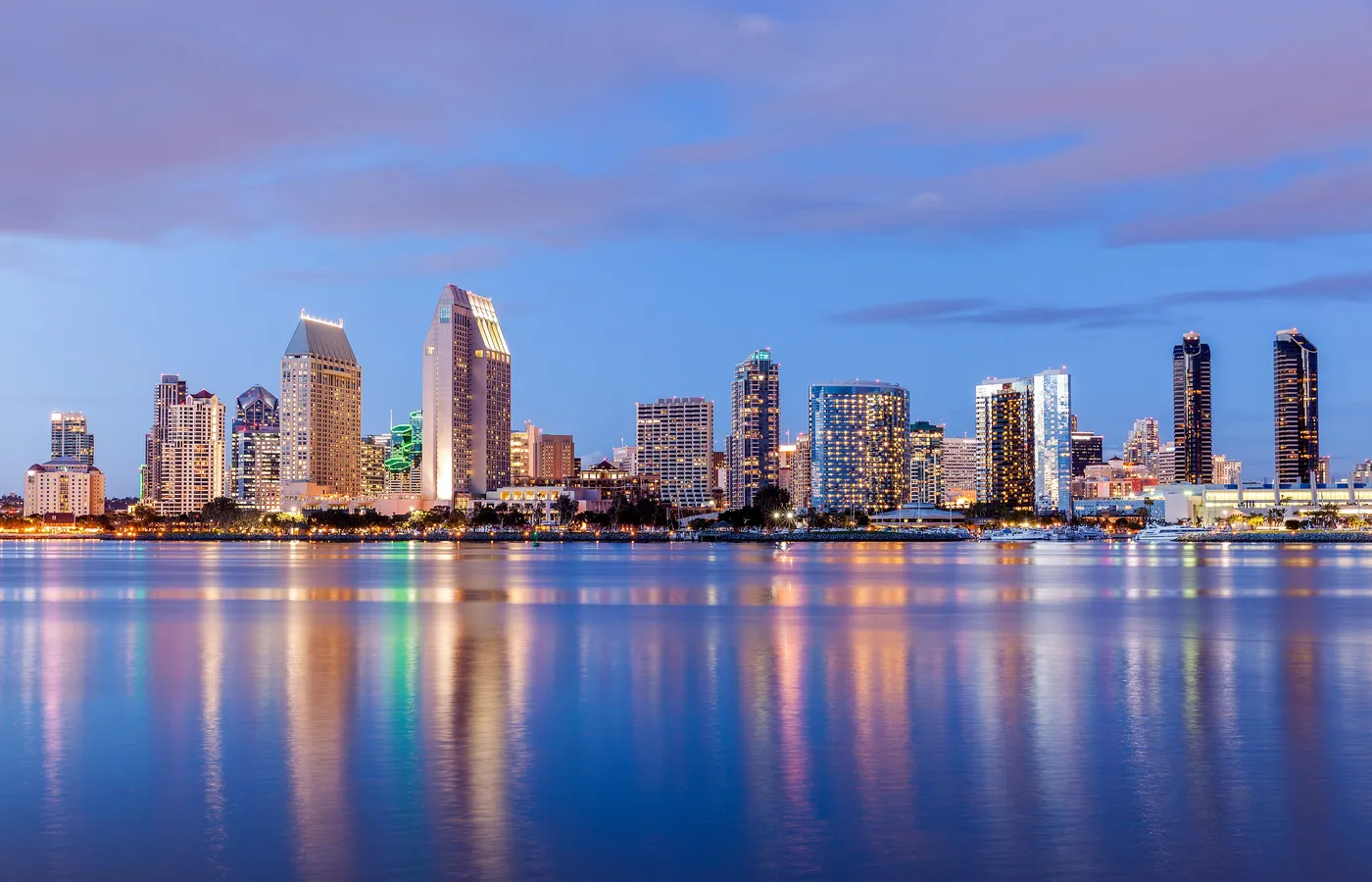
What San Diego is known for
San Diego is situated around a wide natural harbour on the southern coast of California, just north of the border with Mexico. The city is recognised for its maritime setting, expansive public beaches, and an outdoor lifestyle shaped by year-round mild weather and Pacific ocean breezes.
Travellers are drawn to its blend of coastal culture and parklands, along with a deep naval heritage. From the waterfront promenades downtown to the rugged sandstone bluffs along the ocean, San Diego offers a relaxed urban pace where city life connects easily with the natural marine environment.
A short history
Long before European arrival, the Kumeyaay people lived across the region for thousands of years, developing villages along the coast and inland waterways with rich traditions of basketry and marine harvesting. Spanish explorer Juan Rodríguez Cabrillo sailed into the bay in 1542, claiming the area for Spain.
Permanent European settlement began in 1769 with the founding of the Presidio of San Diego and Mission San Diego de Alcalá. The territory shifted to Mexican rule in 1821 following Mexico's independence from Spain, developing a ranching economy centred around what is now preserved as Old Town.
Following the Mexican-American War, San Diego became part of the United States in 1848 and was incorporated as a city in 1850. Alonzo Horton laid out New Town near the waterfront in the late 1860s, shifting commercial activity away from the old settlement and establishing the modern downtown district.
The 1915 Panama-California Exposition in Balboa Park brought international attention and inspired Spanish Colonial Revival architecture across the city. During the twentieth century, extensive naval bases, aviation manufacturing, and scientific research institutions grew around the harbour, shaping the modern metropolitan area.
Neighbourhoods
Downtown features the Gaslamp Quarter, known for its Victorian-era commercial buildings, alongside the embarcadero waterfront where ships dock near green public plazas. Nearby, Barrio Logan serves as an anchor for Mexican-American culture and community art, centred around murals painted beneath highway ramps in Chicano Park.
Along the coastline, distinct communities each present their own character. Ocean Beach retains a laid-back, mid-century surf town atmosphere, while Pacific Beach attracts beachgoers with its long boardwalk. Farther north, La Jolla features sea cliffs, protected coves, and green hills overlooking the ocean.
Food and drink
The local food scene reflects San Diego's proximity to Mexico and its coastal position, creating what is widely known as Cali-Baja cuisine. Grilled fish tacos served with shredded cabbage and lime, California burritos stuffed with carne asada and french fries, and fresh Pacific seafood are regional staples. The city also has a major reputation for craft brewing, with local breweries producing distinct West Coast-style pale ales and IPAs.
Music, arts and culture
San Diego's cultural life is anchored by Balboa Park, a vast urban cultural park that holds more than a dozen museums, performing arts venues, and artist studios. The city hosts professional regional theatre companies, including the Old Globe, alongside the San Diego Symphony at its bayside outdoor venue. Comic-Con International, an annual gathering celebrating comic books and popular media, brings thousands of creators and fans to the convention centre each summer.
Top things to do
Spending a day in Balboa Park is a central experience, where visitors can walk through the Spanish Colonial courtyards, visit the San Diego Museum of Art, and explore the San Diego Zoo. Along the downtown bay, maritime history is preserved aboard the USS Midway Museum, a retired aircraft carrier open for self-guided exploration, and at the Maritime Museum of San Diego, which displays historic sailing vessels.
Outdoor exploration is centred on the coastline. Torrey Pines State Natural Reserve offers hiking paths along coastal bluffs populated by rare pine trees and wild coastal scrub, while La Jolla Cove provides opportunities to observe harbour seals and sea lions resting along the rocks. Across the bay, Coronado features broad, flat sandy beaches and quiet residential avenues suitable for cycling.
Day trips
An easy day trip inland takes travellers to the historic mountain town of Julian, known for its gold-mining past, apple orchards, and fresh cider. To the south, crossing the international border into Tijuana or continuing down the Baja California coast provides an excursion for regional Mexican cooking and coastal scenery. For coastal views heading north, taking the passenger train along the shore toward San Juan Capistrano offers a relaxing journey without the need for a car.
Before you go
Confirm entry rules with official sources before you go, starting with the Government of Canada's United States travel advice. If you plan to drive, see our tip on crossing the border by car.
Nearby starting points on this site include Los Angeles and, across the border in Baja California, Cabo San Lucas.
Best time to go
The coastal climate is mild year-round compared with much of the U.S., with a drier summer and a wetter winter. Late fall through spring can bring the well-known 'May gray' or 'June gloom' marine layer along the shore.
Getting there from Canada
Flights from Canada typically arrive at San Diego International, often via a West Coast or western-Canada connection, sometimes nonstop from Vancouver or other large cities depending on the season.
Official travel advice
Read the Government of Canada's United States travel advice before you go. Rules and conditions can change.
Search flights, cars, tours and airport rides under Plan your trip below. Checkout is on the partner's site.