
What Victoria is known for
Victoria sits at the southern tip of Vancouver Island, where the sheltered waters of the Salish Sea meet mild Pacific air. Known across the country as the City of Gardens, it is recognized for its year-round greenery, seaside walkways, and preserved heritage architecture that reflects its colonial past.
Travellers visit for the relaxed pace, maritime scenery, and compact downtown core set around the Inner Harbour. It is a city where marine wildlife is close to shore, coastal mountain peaks frame the horizon, and walking or cycling along the shoreline is an everyday pastime.
A short history
Long before European arrival, the southern tip of Vancouver Island was home to the Lekwungen-speaking Coast Salish peoples, known today as the Songhees and Esquimalt Nations. They established permanent settlements along the sheltered bays, harvested marine resources from the straits, and maintained open Garry oak meadows to cultivate edible camas bulbs.
In 1843, the Hudson's Bay Company established Fort Victoria as a fur-trading post, naming it in honour of Queen Victoria. The quiet trading outpost expanded quickly during the Fraser Canyon Gold Rush of 1858, when tens of thousands of prospectors and merchants arrived by ship to purchase supplies before crossing to the mainland.
Victoria was incorporated as a city in 1862 and was chosen as the capital of British Columbia in 1871 when the province entered Canadian Confederation. While the rise of transcontinental railways shifted industrial shipping to Vancouver, Victoria retained its role as the administrative, naval, and legislative centre of the province, preserving much of its late nineteenth-century character.
Neighbourhoods
Downtown Victoria centres on the Inner Harbour, where Government Street leads north through heritage brick buildings to Canada's oldest Chinatown and the narrow passage of Fan Tan Alley. Just south of the provincial legislature, James Bay is one of the oldest residential neighbourhoods on the West Coast, featuring quiet streets of Victorian homes that lead out to the oceanfront along Dallas Road.
To the east, Cook Street Village has a community feel defined by leafy streets, neighbourhood grocers, and outdoor patios. Farther east lies Oak Bay, an established district with quiet beaches, Edwardian homes, and coastal viewpoints overlooking the Juan de Fuca Strait.
Food and drink
The local food culture draws heavily from Vancouver Island waters and nearby farm valleys. Pacific seafood such as wild salmon, Dungeness crab, spot prawns, and local oysters are staples on coastal menus. British traditions continue through formal afternoon tea, served with scones, fruit preserves, and savoury finger sandwiches. The region is also an established brewing and cidermaking centre, complemented by cool-climate wines produced in nearby island valleys.
Music, arts and culture
Victoria maintains an active cultural community anchored by long-running civic institutions. Historic venues like the Royal Theatre and the McPherson Playhouse host regular seasons of the Victoria Symphony and Pacific Opera Victoria. Visual art has deep roots here, highlighted by historical public collections featuring the paintings of Victoria-born artist Emily Carr, while independent theatre is celebrated each year through the Victoria Fringe Festival.
Top things to do
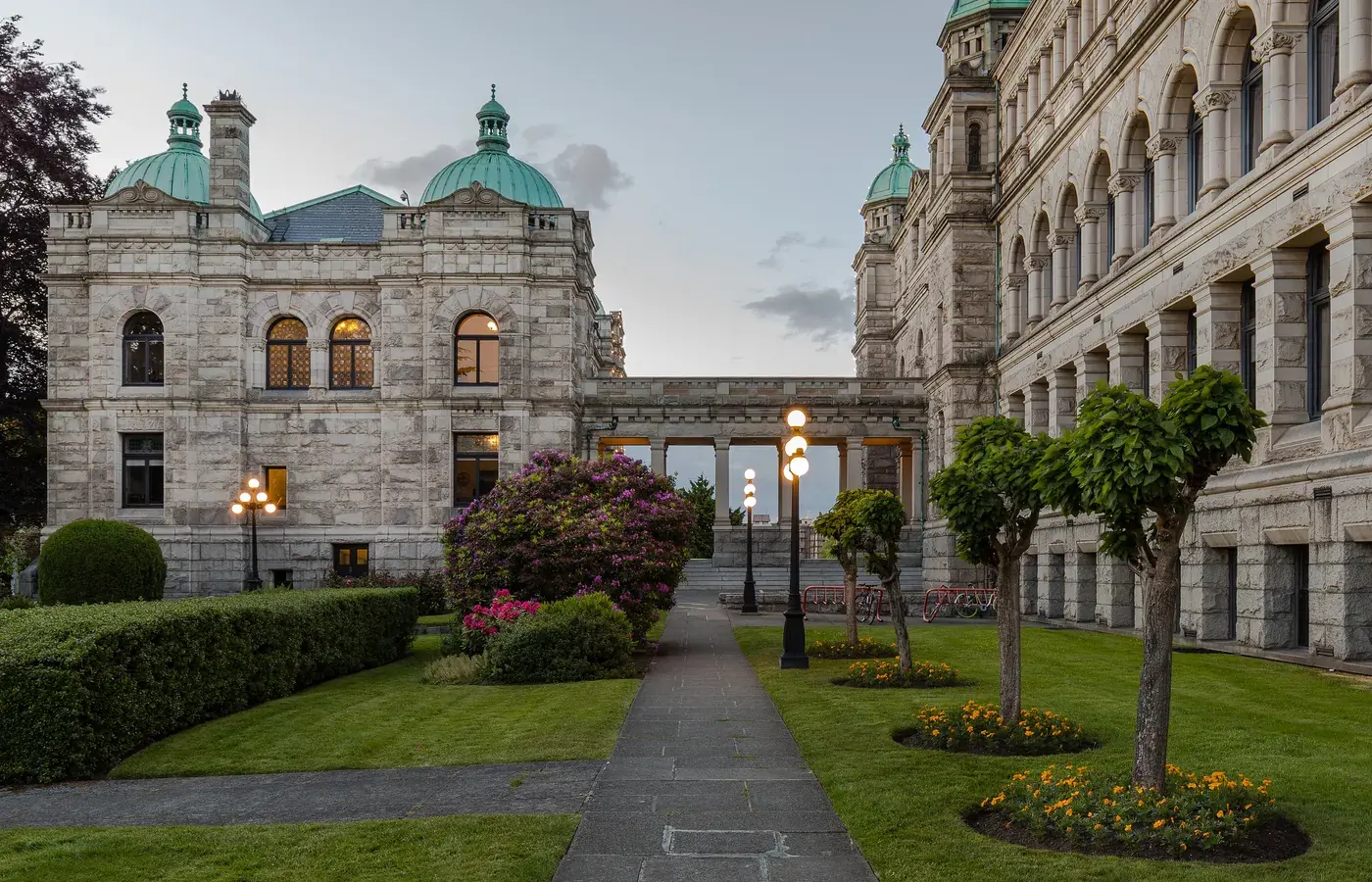
A walk around the Inner Harbour provides a close look at the stone British Columbia Parliament Buildings and the exhibits of natural and cultural history at the Royal BC Museum. Nearby, Beacon Hill Park offers extensive paths through native Garry oak ecosystems, manicured gardens, and peaceful ponds, ending at the Mile Zero marker of the Trans-Canada Highway.
Visitors can tour Craigdarroch Castle, a baronial mansion built in the late nineteenth century that showcases detailed stained glass and Victorian woodwork. A stroll along the waterfront leads to the Ogden Point Breakwater, where a concrete pathway extends into the sea, offering views across the strait to the Olympic Mountains.
Day trips
North of the city in Brentwood Bay, The Butchart Gardens displays historic sunken and formal garden landscapes built inside a former limestone quarry. Westward along the coast, the community of Sooke and the trails of East Sooke Regional Park offer rugged rainforest hikes along rocky ocean bluffs, making for an easy day trip. Travellers can also explore the Saanich Peninsula or travel north toward the Cowichan Valley to visit cideries, farm stands, and quiet seaside villages within a short drive.
Before you go
Ferry, seaplane and air schedules change, check official operators and, for travel advice, Travel advice and advisories before you go.
Many trips combine Victoria with Vancouver on the mainland, or continue into the Interior toward Kelowna.
Best time to go
Victoria is often milder and a little drier than Vancouver. Late spring through early fall is the usual garden and seawall season; winter is cool and wet, with occasional snow. Whale-watching is seasonal and weather-dependent.
Getting there from Canada
Most visitors reach Victoria by flying into Victoria International (near Sidney), by scheduled or walk-on ferry from Metro Vancouver (Tsawwassen or Horseshoe Bay routes, plus the Tsawwassen-Swartz Bay BC Ferries run), or by floatplane or bus-and-ferry. Official BC Ferries and airport pages have current status.
Official travel advice
Travelling inside Canada does not use a country travel-advice page. Use official park, ferry and highway notices where they are mentioned above.
Search flights, cars, tours and airport rides under Plan your trip below. Checkout is on the partner's site.