
What Washington, D.C. is known for
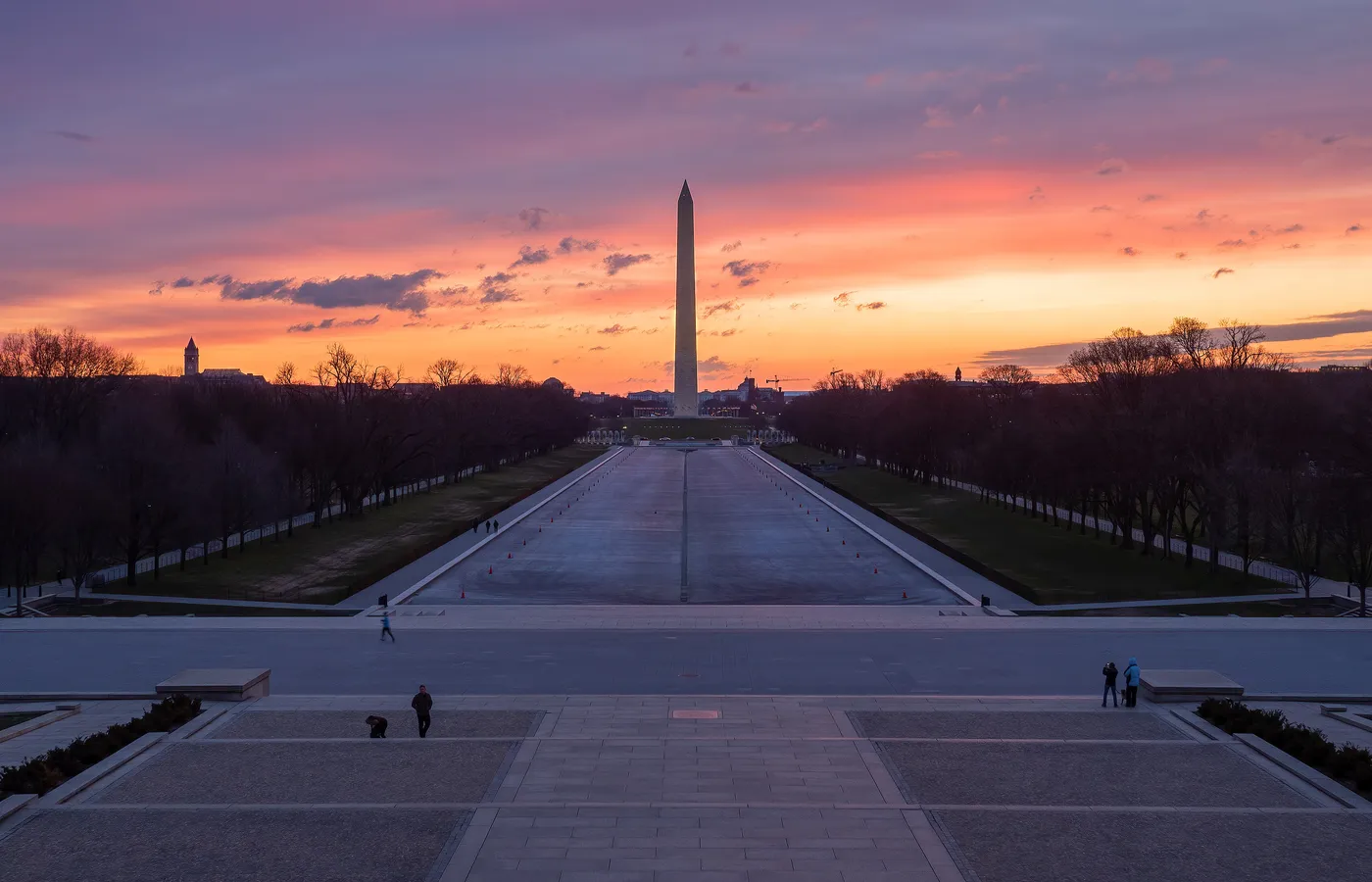
Washington, D.C., is recognized globally as the federal capital of the United States. Its broad avenues, classical marble monuments, and sweeping green spaces give the city an immediate sense of scale and purpose. At its core lies the National Mall, where memorials honour past leaders alongside many of the world's most comprehensive public museums.
Beyond politics and monumental architecture, the city possesses an appealing residential character. Quiet side streets lined with brick rowhouses, leafy parks along the Potomac River, and distinct community quarters give the capital a balanced, livable rhythm. It is a city designed for walking, civic exploration, and engaging directly with American history.
A short history
Before European arrival, the fertile lands at the confluence of the Potomac and Anacostia rivers were inhabited by Indigenous peoples, primarily the Nacotchtank. English colonists arrived in the 17th century, establishing settlements, trade routes, and tobacco plantations across the surrounding region.
In 1790, the United States Congress passed the Residence Act, approving a permanent national capital along the Potomac. President George Washington chose the exact location, and French engineer Pierre Charles L'Enfant surveyed and drafted the master plan, laying out grand ceremonial avenues radiating from public squares. The federal government officially relocated from Philadelphia in 1800, though British troops burned several major public buildings, including the Capitol and the White House, during the War of 1812.
The American Civil War transformed Washington from a sleepy southern town into a heavily fortified union garrison and an important refuge for formerly enslaved people. In the decades that followed, the city developed into an influential centre for African American culture, higher education, and political leadership, earning the enduring moniker "Chocolate City." It also served as the primary gathering ground for major civil rights demonstrations, including the 1963 March on Washington.
Twentieth-century urban planning initiatives reinforced L'Enfant's original vision by preserving open sightlines and restricting commercial building heights. Today, the capital retains its low-rise monumental core while growing into a diverse international metropolis.
Neighbourhoods
Away from the federal centre, Washington divides into varied neighbourhoods with distinct personalities. Georgetown, which predates the capital itself, features cobblestone lanes, preserved 18th-century brick townhouses, and tranquil paths alongside the Chesapeake and Ohio Canal. To the east of the Capitol, Capitol Hill offers tree-lined residential streets, Victorian architecture, and the lively community atmosphere around Eastern Market.
North of downtown, Dupont Circle is known for its energetic public circle, historic embassies along Massachusetts Avenue, and nearby art galleries. Neighbouring Adams Morgan and the historic U Street corridor reflect the city's multicultural fabric and musical history, filled with colourful rowhouses, independent bookshops, and live music venues.
Food and drink
The city's food culture blends mid-Atlantic staples, African American culinary traditions, and an extensive global embassy community. A quintessential local specialty is the half-smoke, a coarse-ground smoked sausage served on a soft bun and typically topped with spicy meat chili, diced onions, and yellow mustard. Another local staple is mumbo sauce, a sweet, tangy condiment common in neighbourhood carry-out shops and often paired with fried chicken wings. The region's proximity to the Chesapeake Bay makes steamed blue crabs and crab cakes popular seasonal choices, while a large Ethiopian diaspora has made injera flatbread and spiced stews an integral part of the local dining landscape.
Music, arts and culture
Washington has made significant contributions to American music, most notably through go-go music, a regional funk subgenre characterized by syncopated polyrhythms, continuous live drumming, and call-and-response vocals that originated in the 1970s. The city was also a focal point for the independent punk and hardcore movements in the late 1970s and 1980s. Fine arts and classical performances anchor the cultural calendar at the John F. Kennedy Center for the Performing Arts and the National Symphony Orchestra, while the Smithsonian Institution and the National Gallery of Art maintain world-class visual art collections open to the public.
Top things to do
The National Mall is the central gathering place for sightseeing, stretching from the Lincoln Memorial and the Washington Monument toward the United States Capitol. Visitors can wander through the open-air memorials dedicated to figures such as Martin Luther King, Jr., Thomas Jefferson, and Franklin Delano Roosevelt, alongside tributes to veterans of the Second World War, the Korean War, and the Vietnam War.
Bordering the green lawn of the Mall are the major public branches of the Smithsonian Institution. Key stops include the National Museum of African American History and Culture, the National Air and Space Museum, the National Museum of American History, and the National Museum of Natural History. Just east of the Capitol grounds, the Library of Congress and the United States Botanic Garden offer striking interior architecture and quiet indoor gardens.
Day trips
Several notable historic and natural destinations are within easy reach of the capital. Mount Vernon, George Washington's 18th-century plantation estate overlooking the Potomac River, makes an easy day trip into northern Virginia. The maritime city of Annapolis, Maryland, with its colonial brick streets and the United States Naval Academy, is a short drive away. For mountain scenery and early American history, Harpers Ferry, West Virginia, sits at the meeting point of the Potomac and Shenandoah rivers and can be reached by a short train ride.
Before you go
Confirm entry rules and site hours with official U.S. sources, and read the Government of Canada's United States travel advice before you go.
Other East Coast starting points on this site include New York and Boston.
Best time to go
Spring (including the cherry-blossom window, whose exact dates change each year) and fall are often the most comfortable. Summers are hot and humid; winters can be cold, with occasional snow.
Getting there from Canada
Flights from Canada use Reagan National, Dulles International or Baltimore/Washington (BWI). Reagan is closest to the National Mall; Dulles and BWI need a longer transfer.
Official travel advice
Read the Government of Canada's United States travel advice before you go. Rules and conditions can change.
Search flights, cars, tours and airport rides under Plan your trip below. Checkout is on the partner's site.