
What Milan is known for
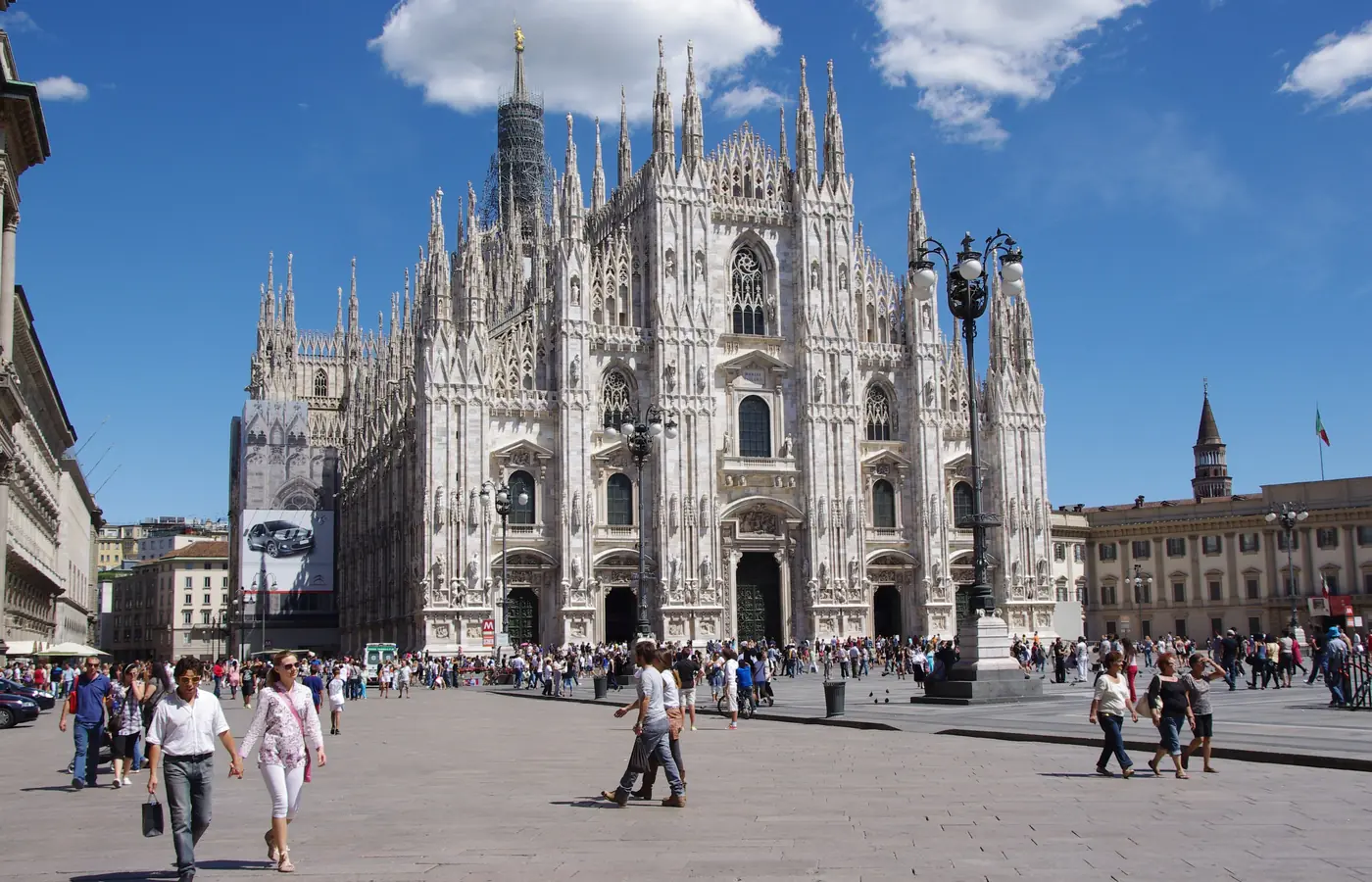
Milan is Italy's financial and commercial engine, but it is equally celebrated for design, fashion, architecture, and art. At its physical centre stands the massive Duomo di Milano, whose pale Candoglia marble spires rise over the main public square.
Unlike Italian cities preserved strictly as open-air monuments, Milan balances high-speed modern industry with centuries of artistic achievement. Visitors encounter a fast-paced urban rhythm paired with quiet cloistered courtyards, grand neoclassical palazzi, and world-renowned collections of Renaissance art.
A short history
Celtic tribes known as the Insubres established a settlement called Mediolanum on the plains of the Po Valley around the early 4th century BC. Roman forces captured the town in 222 BC, developing it into a major trading hub and later an administrative capital of the Western Roman Empire. It was here in 313 AD that the emperors Constantine and Licinius agreed the Edict of Milan, granting legal tolerance to Christianity across the empire.
During the Middle Ages, Milan emerged as a formidable autonomous commune before coming under the control of the Visconti and Sforza families in the 14th and 15th centuries. These dynasties transformed the city into a powerhouse of the Italian Renaissance, commissioning masters like Leonardo da Vinci and Donato Bramante to design fortifications, churches, and civic projects.
Over subsequent centuries, the city passed between Spanish, Austrian, and French rule before joining the unified Kingdom of Italy in 1859. Milan quickly developed as the nation's primary industrial and railway hub, drawing workers from across Italy and driving modern economic growth.
Heavy aerial bombardment during the Second World War damaged parts of the historic centre, leading to postwar reconstruction that integrated modernist design alongside surviving historic fabric. Today, the city stands as a global centre for international commerce, runway fashion, and contemporary design.
Neighbourhoods
The Centro Storico surrounds the Duomo and the glass-domed Galleria Vittorio Emanuele II, extending toward the arts district of Brera. Brera is characterised by narrow paved lanes, 18th-century palazzi, and small public squares. Just to the east, the Quadrilatero della Moda comprises refined streets like Via Monte Napoleone and Via della Spiga, long associated with Italian tailoring and luxury design houses.
Further south, the Navigli neighbourhood retains two historic waterways, the Naviglio Grande and Naviglio Pavese, flanked by footpaths, bridges, and former artisan workshops. To the north, the Porta Nuova district and neighbouring Isola showcase contemporary Milan, with pedestrian plazas, public gardens, and converted industrial spaces.
Food and drink
Traditional Milanese cooking reflects the climate and agriculture of northern Italy, favouring butter, rice, and beef over olive oil and dried pasta. Classic plates include risotto alla milanese, tinted yellow with saffron, and cotoletta alla milanese, a breaded bone-in veal cutlet fried in clarified butter. Slow-braised veal shanks, known as ossobuco, are traditionally accompanied by a citrus and parsley gremolata. Around the winter holidays, bakeries produce panettone, a tall, sweet yeast bread studded with candied fruit. The early evening aperitivo remains a firm daily habit, with locals meeting for bitter herbal spirits, local wines, and savoury snacks.
Music, arts and culture
Milan maintains a high place in visual art and musical history. Teatro alla Scala, built in the late 18th century, has long served as a premier venue for Italian opera, closely tied to composers such as Giuseppe Verdi and Giacomo Puccini. The Pinacoteca di Brera holds significant Italian paintings from the Renaissance and Baroque eras, including works by Raphael, Mantegna, and Caravaggio. Modern and decorative arts are featured at the Triennale di Milano in Parco Sempione, which documents Italy's influential contributions to industrial, furniture, and graphic design.
Top things to do
A walk across the rooftop terraces of the Duomo offers close views of hundreds of stone pinnacles and statues, as well as panoramic views across the urban grid. Across the square, the 19th-century Galleria Vittorio Emanuele II provides an impressive walkway covered by arched glass and cast-iron vaults. A short stroll leads to the Castello Sforzesco, a vast brick fortress that houses municipal museums and opens into the expansive grounds of Parco Sempione.
In the refectory of the convent of Santa Maria delle Grazie, visitors can view Leonardo da Vinci's mural of The Last Supper. Nearby, the church of San Maurizio al Monastero Maggiore contains wall-to-wall 16th-century frescoes, while the Pinacoteca Ambrosiana displays master drawings and rare manuscripts. For contemporary sights, Piazza Gae Aulenti offers modern architecture, including the Bosco Verticale residential towers covered in thousands of trees and shrubs.
Day trips
Milan's central railway network makes regional travel simple. Lake Como is an easy day trip by train, where travellers can explore lakeside paths, ferry routes, and historic villas in towns such as Como and Varenna against an Alpine backdrop. The historic city of Bergamo, with its elevated upper town enclosed by 16th-century Venetian walls, is also a short train ride away. Travellers can also reach Brescia to examine excavated Roman public buildings, or head south to Pavia to visit the historic university quarter and the nearby monastery complex of the Certosa di Pavia.
Before you go
Confirm entry rules with official sources before you go, starting with the Government of Canada's Italy travel advice. Hours and closures change, we don't list them here.
Other Italian starting points on this site include Rome, Florence and Venice.
Best time to go
Late spring and early fall are often comfortable. Summers can be hot and humid; winters are cool, foggy or damp, with short days. August sees some shop and restaurant closures. The city is a year-round rail and air hub for northern Italy.
Getting there from Canada
Flights from Canada typically arrive at Milan Malpensa, usually via a European hub, with some nonstops. Linate is closer to the centre; Bergamo (Orio al Serio) is further out. Official airport trains and buses run into the city.
Official travel advice
Read the Government of Canada's Italy travel advice before you go. Rules and conditions can change.
Search flights, cars, tours and airport rides under Plan your trip below. Checkout is on the partner's site.