
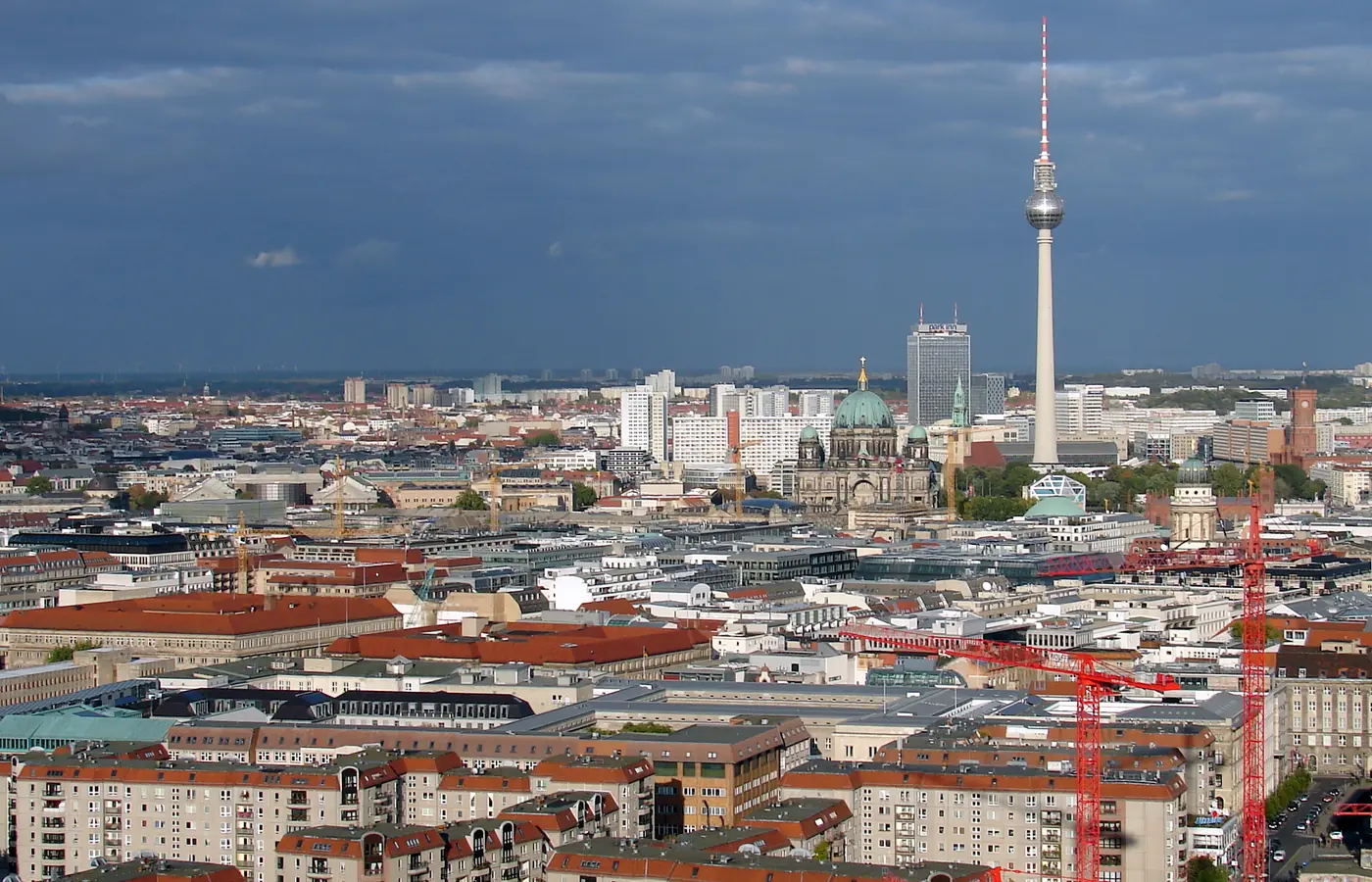
What Berlin is known for
Berlin stands apart from other European capitals because of its spacious layout, abundant green spaces, and layered modern history. Straddling the River Spree, it is a city of distinct quarters where broad tree-lined boulevards meet quiet courtyards, and classical 19th-century architecture sits alongside utilitarian postwar design.
Travellers are drawn to a city defined by constant reinvention and open civic space. Decades of postwar division left Berlin with duplicate cultural institutions, expansive public parks, and a relaxed pace of daily life that makes exploring by foot or public transit particularly rewarding.
A short history
The area around the Spree and Havel rivers was inhabited by Slavic communities in the early Middle Ages before German merchants established the twin trading settlements of Berlin and Cölln in the late 12th and early 13th centuries. The two towns formally joined together in the early 14th century and later became the permanent residence of the Hohenzollern rulers of Brandenburg in the 15th century.
Over the following centuries, Berlin expanded from a regional seat into the capital of the Kingdom of Prussia and, after 1871, the capital of a unified German Empire. Industrial growth brought rapid urban expansion, turning the city into a major European centre for science, manufacturing, and commerce by the turn of the 20th century.
The mid-20th century brought profound devastation. Berlin suffered heavy destruction during the Second World War and was subsequently partitioned into American, British, French, and Soviet sectors. The construction of the Berlin Wall in 1961 physically divided the city for nearly three decades, separating families and creating distinct social and political systems on either side.
The opening of the border in November 1989 set the stage for German reunification in 1990 and the return of the federal government to Berlin. The years since have seen major reconstruction along the former border strip, linking East and West while preserving historic memorials and civic spaces across the city.
Neighbourhoods
Berlin is organized into several distinct localities, known locally as Kiez, each with its own character. Mitte forms the central core, containing Museum Island, government buildings, and wide historic avenues like Unter den Linden. Directly north, Prenzlauer Berg features restored 19th-century residential buildings, quiet leafy streets, and public squares that host regular open-air markets.
South and east across the River Spree, Kreuzberg and Friedrichshain feature a strong community feel shaped by decades of alternative culture, independent arts spaces, and riverfront paths. Further west, Charlottenburg offers a quieter, classical atmosphere centred around wide avenues, historic pre-war apartment blocks, and the green grounds of Charlottenburg Palace.
Food and drink
Berlin's food traditions are casual and influenced by both regional Prussian cooking and generations of international migration. Popular street foods include currywurst, a sliced pork sausage served with spiced curry ketchup, and the Berlin-style Döner kebab, popularized by Turkish guest workers in the early 1970s. Traditional sit-down meals often feature Eisbein (simmered pork knuckle with sauerkraut and pea purée), potato soup, and Buletten, which are pan-fried seasoned meatballs. Local drinks include crisp German lagers and Berliner Weisse, a low-alcohol, sour wheat beer traditionally served with a dash of green woodruff or red raspberry syrup.
Music, arts and culture
Berlin possesses an exceptional concentration of publicly funded cultural institutions, including three major opera houses, major municipal drama theatres, and world-renowned orchestras such as the Berlin Philharmonic. Visual art is equally prominent, anchored by Museum Island, a UNESCO World Heritage site housing five major national museums. In addition to classical institutions, the city is widely recognized for contemporary art, public murals along the remaining portions of the Berlin Wall, and a longstanding electronic music culture rooted in repurposed industrial buildings.
Top things to do
A central walking route through Mitte connects many of the city's key landmarks, beginning at the Brandenburg Gate and leading past the Reichstag building with its modern glass dome. Nearby, the Memorial to the Murdered Jews of Europe provides a solemn space for reflection in the city centre. Continuing east down Unter den Linden brings you to Museum Island, the Berlin Cathedral, and Alexanderplatz, where the Fernsehturm provides wide views across the region.
To explore Berlin's Cold War history, walk along the East Side Gallery, an open-air gallery painted directly on a preserved section of the Berlin Wall, or visit the outdoor Berlin Wall Memorial along Bernauer Strasse. For relaxation, take a stroll through the Tiergarten park or visit Tempelhofer Feld, a former municipal airport whose open runways are now used by the public for cycling, running, and community gardening.
Day trips
A short train ride southwest of the capital brings you to Potsdam, the former residence of Prussian kings, renowned for its grand palaces and the expansive gardens of Sanssouci Park. Another popular outing is an easy day trip south to the Spreewald, a UNESCO biosphere reserve characterized by hundreds of quiet waterways that visitors explore by kayak or traditional flat-bottomed punt. Closer to the city limits, the lakes around Wannsee offer public beaches, sailing, and scenic walking trails along the forested shoreline.
Before you go
Confirm entry rules with official sources before you go, starting with the Government of Canada's Germany travel advice. Hours and closures change, we don't list them here.
Other European starting points on this site include Prague, Vienna, Copenhagen and Amsterdam.
Best time to go
Late spring through early fall is the usual outdoor season. Winters are cold and grey, with short days and a chance of snow. Summers can be warm, with long evenings in parks and on the river.
Getting there from Canada
Flights from Canada typically arrive at Berlin Brandenburg (BER), usually via a European hub, with some nonstops. Official rail and buses run into the city. The S-Bahn, U-Bahn and a lot of walking cover the districts; the city is large and spread out.
Official travel advice
Read the Government of Canada's Germany travel advice before you go. Rules and conditions can change.
Search flights, cars, tours and airport rides under Plan your trip below. Checkout is on the partner's site.